Advertisements
Advertisements
प्रश्न
O is any point in the interior of ΔABC. Prove that
(i) AB + AC > OB + OC
(ii) AB + BC + CA > OA + QB + OC
(iii) OA + OB + OC >` 1/2`(AB + BC + CA)
Advertisements
उत्तर
Given that O is any point in the interior of ABC
We have to prove
(i) AB + AC > OB + OC
(ii) AB + BC + CA > OA + QB + OC
(iii) OA + OB + OC >`1/2`(AB + BC + CA)
We know that, in a triangle the sum of any two sides is greater than the third side So, we have
In ΔABC
AB+BC>AC
BC+AC>AB
AC+AB>BC
In ΔOBC
OB+OC>BC ...........(1)
In ΔOAC
OA+OC>AC ...........(2)
In ΔOAB
OA+OB>AB ............(3)
Now, extend (or) produce BO to meet AC in D.
Now, in ΔABD,we have
AB+AD+BD
⇒ AB+AD>BO+OD .............(4) [∵ BD=BO+OD]
Similarly in , ΔODC we have
OD+DC>OC ...............(5)
(1) Adding (4) and (5), we get
AB+AD+OD+DC>BO+OD+OC
⇒AB+(AD+DC)>OB+OC
⇒ AB+AC>OB+OC ...............(6)
Similarly, we have
BC+BA>OA+OC ...............(7)
and CA+CB>OA+OB ..............(8)
(2) Adding equation (6), (7) and (8), we get
AB+AC+BC+BA+CA+CB>OB+OC+OA+OC+OA+OB
⇒2AB+2BC+CA>2OA+2OB+2OC
⇒2(AB+BC+CA>OA+OB+OC)
⇒AB+BC+CA>OA+OB+OC
(3) Adding equations (1), (2) and (3)
OB+OC+OA+OC+OA+OB+>BC+AC+AB
⇒2OA+2OB+2OC>AB+BC+CA
We get⇒ 2(OA+OB+OC)>AB+BC+CA
∴ (OA+OB+OC)>`1/2`(AB+BC+CA)
APPEARS IN
संबंधित प्रश्न
Show that the angles of an equilateral triangle are 60° each.
In an isosceles triangle, if the vertex angle is twice the sum of the base angles, calculate the angles of the triangle.
PQR is a triangle in which PQ = PR and S is any point on the side PQ. Through S, a line is drawn parallel to QR and intersecting PR at T. Prove that PS = PT.
Which of the following statements are true (T) and which are false (F):
Angles opposite to equal sides of a triangle are equal
Which of the following statements are true (T) and which are false (F):
The bisectors of two equal angles of a triangle are equal
Fill the blank in the following so that the following statement is true.
In an isosceles triangle ABC with AB = AC, if BD and CE are its altitudes, then BD is …… CE.
In ΔABC, side AB is produced to D so that BD = BC. If ∠B = 60° and ∠A = 70°, prove that: (i) AD > CD (ii) AD > AC
Prove that the perimeter of a triangle is greater than the sum of its altitudes.
Which of the following statements are true (T) and which are false (F)?
Sum of any two sides of a triangle is greater than the third side.
Which of the following statements are true (T) and which are false (F)?
If two angles of a triangle are unequal, then the greater angle has the larger side opposite to it.
Fill in the blank to make the following statement true.
In a right triangle the hypotenuse is the .... side.
Write the sum of the angles of an obtuse triangle.
If the angles of a triangle are in the ratio 2 : 1 : 3, then find the measure of smallest angle.
In the given figure, if EC || AB, ∠ECD = 70° and ∠BDO = 20°, then ∠OBD is
In the given figure, x + y =
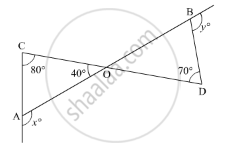
In the given figure, what is the value of x?
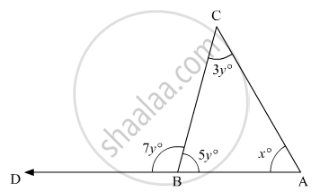
The angles of a right angled triangle are
Which of the following correctly describes the given triangle?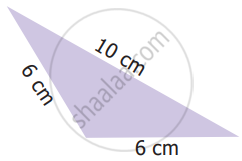
It is given that ∆ABC ≅ ∆FDE and AB = 5 cm, ∠B = 40° and ∠A = 80°. Then which of the following is true?
Is it possible to construct a triangle with lengths of its sides as 8 cm, 7 cm and 4 cm? Give reason for your answer.
