Advertisements
Advertisements
प्रश्न
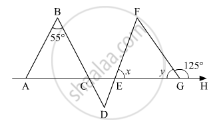
In the given figure, if AB || DE and BD || FG such that ∠FGH = 125° and ∠B = 55°, find x and y.
Advertisements
उत्तर
In the given figure,,,and AB ||DE ,BD || FG , ∠FGH =125° and ∠B = 55°
We need to find the value of x and y
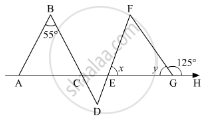
Here, as AB || DE and BD is the transversal, so according to the property, “alternate interior angles are equal”, we get
∠D = ∠B
∠D = 55° ............. (1)
Similarly, as BD || FG and DF is the transversal
∠D = ∠F
∠F = 55° (Using 1)
Further, EGH is a straight line. So, using the property, angles forming a linear pair are supplementary
∠FGE + ∠FGH = 180°
y + 125° = 180°
y = 180° - 125°
y = 55°
Also, using the property, “an exterior angle of a triangle is equal to the sum of the two opposite interior angles”, we get,
In ΔEFG with ∠ FGH as its exterior angle
ext. ∠FGH = ∠F + ∠E
125° = 55° + x
x = 125° - 55°
x = 70°
Thus, x = 70° and y = 55°
APPEARS IN
संबंधित प्रश्न
ΔABC is an isosceles triangle in which AB = AC. Side BA is produced to D such that AD = AB (see the given figure). Show that ∠BCD is a right angle.

In a ΔABC, if ∠A=l20° and AB = AC. Find ∠B and ∠C.
Prove that the medians of an equilateral triangle are equal.
PQR is a triangle in which PQ = PR and S is any point on the side PQ. Through S, a line is drawn parallel to QR and intersecting PR at T. Prove that PS = PT.
P is a point on the bisector of an angle ∠ABC. If the line through P parallel to AB meets BC at Q, prove that triangle BPQ is isosceles.
In a ΔPQR, if PQ = QR and L, M and N are the mid-points of the sides PQ, QR and RP
respectively. Prove that LN = MN.
Which of the following statements are true (T) and which are false (F):
The two altitudes corresponding to two equal sides of a triangle need not be equal.
Fill the blank in the following so that the following statement is true.
Angle opposite to equal sides of a triangle are .....
In a ΔABC, if ∠B = ∠C = 45°, which is the longest side?
Is it possible to draw a triangle with sides of length 2 cm, 3 cm and 7 cm?
Fill in the blank to make the following statement true.
Difference of any two sides of a triangle is........ than the third side.
In the given figure, the sides BC, CA and AB of a Δ ABC have been produced to D, E and F respectively. If ∠ACD = 105° and ∠EAF = 45°, find all the angles of the Δ ABC.
Write the sum of the angles of an obtuse triangle.
In ΔABC, if ∠A = 100°, AD bisects ∠A and AD ⊥ BC. Then, ∠B =
In the given figure, if EC || AB, ∠ECD = 70° and ∠BDO = 20°, then ∠OBD is
If the measures of angles of a triangle are in the ratio of 3 : 4 : 5, what is the measure of the smallest angle of the triangle?
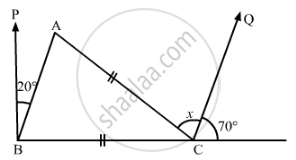
In the given figure, if BP || CQ and AC = BC, then the measure of x is
ABC is an isosceles triangle with AB = AC and D is a point on BC such that AD ⊥ BC (Figure). To prove that ∠BAD = ∠CAD, a student proceeded as follows:
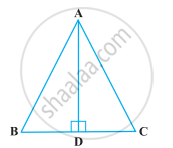
In ∆ABD and ∆ACD,
AB = AC (Given)
∠B = ∠C (Because AB = AC)
and ∠ADB = ∠ADC
Therefore, ∆ABD ≅ ∆ACD (AAS)
So, ∠BAD = ∠CAD (CPCT)
What is the defect in the above arguments?
[Hint: Recall how ∠B = ∠C is proved when AB = AC].
Show that in a quadrilateral ABCD, AB + BC + CD + DA < 2(BD + AC)
