Advertisements
Advertisements
प्रश्न
In the given figure, what is y in terms of x?
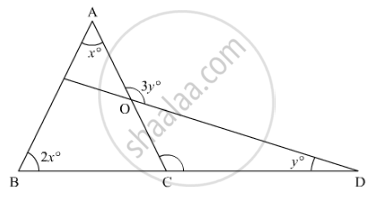
विकल्प
- \[\frac{3}{2}x\]
- \[\frac{4}{3}x\]
- x
\[\frac{3}{4}x\]
Advertisements
उत्तर
In the given figure, we need to find y in terms of x
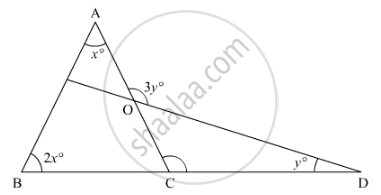
Now, using the property, “an exterior angle of the triangle is equal to the sum of the two opposite interior angles”, we get
In ΔABC
ext∠ACD = ∠CAB + ∠CBA
ext∠ACD = x + 2x
ext∠ACD =3x ..........(1)
Similarly, in ΔOCD
ext∠AOD = ∠OCD + ∠CDO
3y = ∠OCD + y (using 1)
3y - y = 3x
2y = 3x
`y = 3/2 x`
Thus, `y = 3/2x `
APPEARS IN
संबंधित प्रश्न
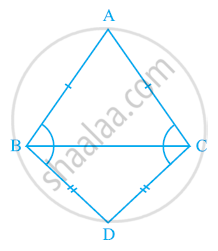
ABC and DBC are two isosceles triangles on the same base BC (see the given figure). Show that ∠ABD = ∠ACD.
If the base of an isosceles triangle is produced on both sides, prove that the exterior angles so formed are equal to each other.
The vertical angle of an isosceles triangle is 100°. Find its base angles.
BD and CE are bisectors of ∠B and ∠C of an isosceles ΔABC with AB = AC. Prove that BD = CE.
In an isosceles triangle, if the vertex angle is twice the sum of the base angles, calculate the angles of the triangle.
Prove that each angle of an equilateral triangle is 60°.
In ΔABC, if ∠A = 40° and ∠B = 60°. Determine the longest and shortest sides of the triangle.
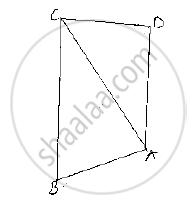
In Fig. 10.131, prove that: (i) CD + DA + AB + BC > 2AC (ii) CD + DA + AB > BC
Which of the following statements are true (T) and which are false (F)?
Sum of any two sides of a triangle is greater than the third side.
Fill in the blank to make the following statement true.
In a right triangle the hypotenuse is the .... side.
In the given figure, the sides BC, CA and AB of a Δ ABC have been produced to D, E and F respectively. If ∠ACD = 105° and ∠EAF = 45°, find all the angles of the Δ ABC.
If the angles of a triangle are in the ratio 2 : 1 : 3, then find the measure of smallest angle.
If the angles A, B and C of ΔABC satisfy the relation B − A = C − B, then find the measure of ∠B.
If the bisectors of the acute angles of a right triangle meet at O, then the angle at Obetween the two bisectors is
Which of the following correctly describes the given triangle?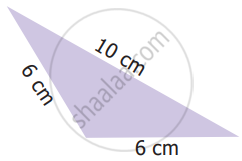
Two sides of a triangle are of lengths 5 cm and 1.5 cm. The length of the third side of the triangle cannot be ______.
In ∆PQR, ∠P = 70° and ∠R = 30°. Which side of this triangle is the longest? Give reason for your answer.
Bisectors of the angles B and C of an isosceles triangle ABC with AB = AC intersect each other at O. Show that external angle adjacent to ∠ABC is equal to ∠BOC
In a triangle ABC, D is the mid-point of side AC such that BD = `1/2` AC. Show that ∠ABC is a right angle.
