Advertisements
Advertisements
प्रश्न
Two sides of a triangle are of lengths 5 cm and 1.5 cm. The length of the third side of the triangle cannot be ______.
विकल्प
3.6 cm
4.1 cm
3.8 cm
3.4 cm
Advertisements
उत्तर
Two sides of a triangle are of lengths 5 cm and 1.5 cm. The length of the third side of the triangle cannot be 3.4 cm.
Explanation:
Given, the length of two sides of a triangle are 5 cm and 1.5 cm, respectively.
Let sides AB = 5 cm and CA = 1.5 cm
We know that, a closed figure formed by three intersecting lines (or sides) is called a triangle, if difference of two sides < third side and sum of two sides > third side
∴ 5 – 1.5 < BC and 5 + 1.5 > BC
⇒ 3.5 < BC and 6.5 > BC
Here, we see that options (a), (b) and (c) satisfy the above inequality but option (d) does not satisfy the above inequality.
APPEARS IN
संबंधित प्रश्न
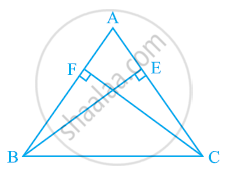
ABC is a triangle in which altitudes BE and CF to sides AC and AB are equal (see the given figure). Show that
- ΔABE ≅ ΔACF
- AB = AC, i.e., ABC is an isosceles triangle.
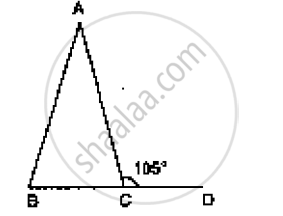
In Figure AB = AC and ∠ACD =105°, find ∠BAC.
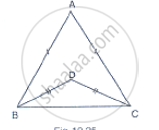
In figure, AB = AC and DB = DC, find the ratio ∠ABD : ∠ACD
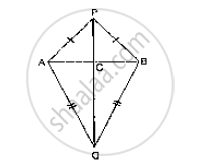
AB is a line seg P and Q are points on opposite sides of AB such that each of them is equidistant from the points A and B (See Fig. 10.26). Show that the line PQ is perpendicular bisector of AB.
Two lines AB and CD intersect at O such that BC is equal and parallel to AD. Prove that the lines AB and CD bisect at O.
In Fig. 10.23, PQRS is a square and SRT is an equilateral triangle. Prove that
(i) PT = QT (ii) ∠TQR = 15°
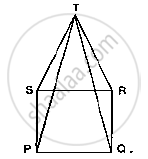
The vertical angle of an isosceles triangle is 100°. Find its base angles.
Find the measure of each exterior angle of an equilateral triangle.
Two lines AB and CD intersect at O such that BC is equal and parallel to AD. Prove that the lines AB and CD bisect at O.
ABC is a triangle in which BE and CF are, respectively, the perpendiculars to the sides AC and AB. If BE = CF, prove that ΔABC is isosceles
Which of the following statements are true (T) and which are false (F):
The bisectors of two equal angles of a triangle are equal
Which of the following statements are true (T) and which are false (F):
If the bisector of the vertical angle of a triangle bisects the base, then the triangle may be isosceles.
Fill the blank in the following so that the following statement is true.
Angle opposite to equal sides of a triangle are .....
Fill the blank in the following so that the following statement is true.
If altitudes CE and BF of a triangle ABC are equal, then AB = ....
Which of the following statements are true (T) and which are false (F)?
Sum of the three sides of a triangle is less than the sum of its three altitudes.
Line segments AB and CD intersect at O such that AC || DB. If ∠CAB = 45° and ∠CDB = 55°, then ∠BOD =
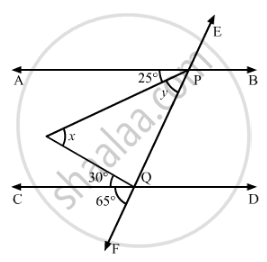
In the given figure, AB and CD are parallel lines and transversal EF intersects them at Pand Q respectively. If ∠APR = 25°, ∠RQC = 30° and ∠CQF = 65°, then
In ∆ABC, AB = AC and ∠B = 50°. Then ∠C is equal to ______.
In ∆PQR, if ∠R > ∠Q, then ______.
Show that in a quadrilateral ABCD, AB + BC + CD + DA < 2(BD + AC)
