Advertisements
Advertisements
प्रश्न
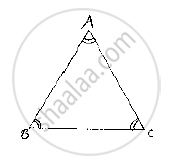
Angles A, B, C of a triangle ABC are equal to each other. Prove that ΔABC is equilateral.
Advertisements
उत्तर
Given that angles A,B,C of a triangle ABC equal to each other.
We have to prove that ΔABC is equilateral We have, ∠A = ∠B =∠C
Now,
[Opposite sides to equal angles are equal]
and ∠B = ∠C ⇒ AC = AB
From the above we get
AB= BC =AC
⇒ ΔABC is equilateral
APPEARS IN
संबंधित प्रश्न
In ΔABC, AD is the perpendicular bisector of BC (see the given figure). Show that ΔABC is an isosceles triangle in which AB = AC.

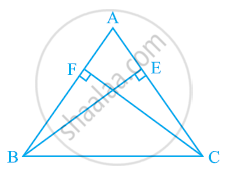
ABC is a triangle in which altitudes BE and CF to sides AC and AB are equal (see the given figure). Show that
- ΔABE ≅ ΔACF
- AB = AC, i.e., ABC is an isosceles triangle.
In a ΔABC, if ∠A=l20° and AB = AC. Find ∠B and ∠C.
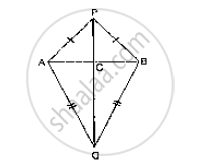
AB is a line seg P and Q are points on opposite sides of AB such that each of them is equidistant from the points A and B (See Fig. 10.26). Show that the line PQ is perpendicular bisector of AB.
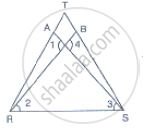
In Fig. 10.40, it is given that RT = TS, ∠1 = 2∠2 and ∠4 = 2∠3. Prove that ΔRBT ≅ ΔSAT
In a ΔABC, if AB = AC and ∠B = 70°, find ∠A.
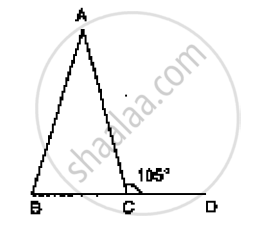
In Figure 10.24, AB = AC and ∠ACD =105°, find ∠BAC.
Fill the blank in the following so that the following statement is true.
Angle opposite to equal sides of a triangle are .....
Fill the blank in the following so that the following statement is true.
If altitudes CE and BF of a triangle ABC are equal, then AB = ....
Is it possible to draw a triangle with sides of length 2 cm, 3 cm and 7 cm?
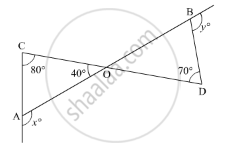
In the given figure, x + y =
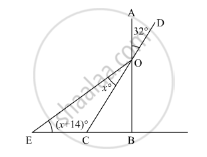
In the given figure, if AB ⊥ BC. then x =
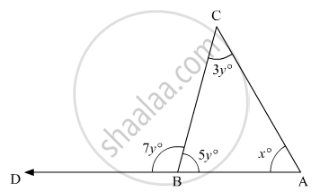
In the given figure, what is the value of x?
The angles of a right angled triangle are
In ∆PQR, ∠R = ∠P and QR = 4 cm and PR = 5 cm. Then the length of PQ is ______.
In ∆PQR, if ∠R > ∠Q, then ______.
AD is a median of the triangle ABC. Is it true that AB + BC + CA > 2AD? Give reason for your answer.
Is it possible to construct a triangle with lengths of its sides as 8 cm, 7 cm and 4 cm? Give reason for your answer.
In a triangle ABC, D is the mid-point of side AC such that BD = `1/2` AC. Show that ∠ABC is a right angle.
