Advertisements
Advertisements
प्रश्न
In a ΔABC, ∠A = 50° and BC is produced to a point D. If the bisectors of ∠ABC and ∠ACDmeet at E, then ∠E =
विकल्प
25°
50°
100°
75°
Advertisements
उत्तर
In the given figure, bisectors of ∠ABCand ∠ACDmeet at E and ∠BAC = 50°
We need to find ∠BEC
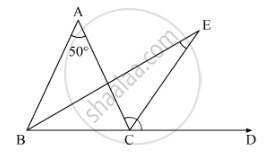
Here, using the property, “an exterior angle of the triangle is equal to the sum of the opposite interior angles”, we get,
In ΔABC with ∠ACD as its exterior angle
ext . ∠ACD = ∠A + ∠ABC ........(1)
Similarly, in Δ BECwith ∠ECDas its exterior angle
ext . ∠ECD = ∠EBC + ∠BEC
`1/2 ∠ACD = 1/2 ∠ABC + BEC`
(CE and BE are the bisectors of ∠ACD and ∠ABC)
∠BEC = 1/2 ∠ACD - 1/2 ∠ABC .......(2)
Now, multiplying both sides of (1) by 1/2
We get,
`1/2 ∠ACD = 1/2 ∠A +1/2 ∠ABC`
`1/2 ∠A = 1/2 ∠ACD - 1/2 ∠ABC` ......(3)
From (2) and (3) we get,
`∠BEC =1/2 ∠A`
`∠BEC =1/2 (50°)`
`∠BEC = 25°`
Thus, `∠BEC = 25°`
APPEARS IN
संबंधित प्रश्न
ABC is an isosceles triangle in which altitudes BE and CF are drawn to equal sides AC and AB respectively (see the given figure). Show that these altitudes are equal.

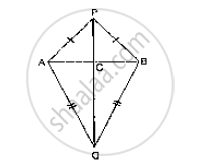
AB is a line seg P and Q are points on opposite sides of AB such that each of them is equidistant from the points A and B (See Fig. 10.26). Show that the line PQ is perpendicular bisector of AB.
Two lines AB and CD intersect at O such that BC is equal and parallel to AD. Prove that the lines AB and CD bisect at O.
If the base of an isosceles triangle is produced on both sides, prove that the exterior angles so formed are equal to each other.
In an isosceles triangle, if the vertex angle is twice the sum of the base angles, calculate the angles of the triangle.
In a ΔABC, it is given that AB = AC and the bisectors of ∠B and ∠C intersect at O. If M is a point on BO produced, prove that ∠MOC = ∠ABC.
Which of the following statements are true (T) and which are false (F) :
If the altitude from one vertex of a triangle bisects the opposite side, then the triangle may be isosceles.
Which of the following statements are true (T) and which are false (F):
The two altitudes corresponding to two equal sides of a triangle need not be equal.
Is it possible to draw a triangle with sides of length 2 cm, 3 cm and 7 cm?
In the given figure, the sides BC, CA and AB of a Δ ABC have been produced to D, E and F respectively. If ∠ACD = 105° and ∠EAF = 45°, find all the angles of the Δ ABC.
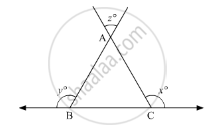
In the given figure, what is z in terms of x and y?
D is a point on the side BC of a ∆ABC such that AD bisects ∠BAC. Then ______.
In triangles ABC and PQR, AB = AC, ∠C = ∠P and ∠B = ∠Q. The two triangles are ______.
If ∆PQR ≅ ∆EDF, then is it true to say that PR = EF? Give reason for your answer
In the following figure, D and E are points on side BC of a ∆ABC such that BD = CE and AD = AE. Show that ∆ABD ≅ ∆ACE.

Bisectors of the angles B and C of an isosceles triangle ABC with AB = AC intersect each other at O. Show that external angle adjacent to ∠ABC is equal to ∠BOC
Show that in a quadrilateral ABCD, AB + BC + CD + DA < 2(BD + AC)
In a triangle ABC, D is the mid-point of side AC such that BD = `1/2` AC. Show that ∠ABC is a right angle.
