Advertisements
Advertisements
प्रश्न
M is a point on side BC of a triangle ABC such that AM is the bisector of ∠BAC. Is it true to say that perimeter of the triangle is greater than 2 AM? Give reason for your answer.
Advertisements
उत्तर
Yes, In ΔABC, M is a point of side BC such that AM is the bisector of ∠BAC.
In ΔABM, AB + BM > AM ...(i) [Sum of two sides of a triangle is greater than the third side]
In ΔACM, AC + CM > AM ...(ii) [Sum of two sides of a triangle is greater than the third side]
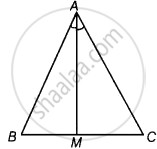
On adding equations (i) and (ii), we get
(AB + BM + AC + CM) > 2AM
⇒ (AB + BM + MC + AC) > 2AM
⇒ AB + BC + AC > 2AM ...[∵ BC = BM + MC]
∴ Perimeter of ΔABC > 2AM
APPEARS IN
संबंधित प्रश्न
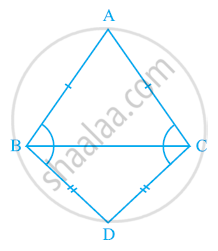
ABC and DBC are two isosceles triangles on the same base BC (see the given figure). Show that ∠ABD = ∠ACD.
ΔABC is an isosceles triangle in which AB = AC. Side BA is produced to D such that AD = AB (see the given figure). Show that ∠BCD is a right angle.

Determine the measure of each of the equal angles of a right-angled isosceles triangle.
In a ΔABC, if AB = AC and ∠B = 70°, find ∠A.
In an isosceles triangle, if the vertex angle is twice the sum of the base angles, calculate the angles of the triangle.
PQR is a triangle in which PQ = PR and S is any point on the side PQ. Through S, a line is drawn parallel to QR and intersecting PR at T. Prove that PS = PT.
Fill the blank in the following so that the following statement is true.
In an isosceles triangle ABC with AB = AC, if BD and CE are its altitudes, then BD is …… CE.
Which of the following statements are true (T) and which are false (F)?
Sum of any two sides of a triangle is greater than twice the median drawn to the third side.
Which of the following statements are true (T) and which are false (F)?
Of all the line segments that can be drawn from a point to a line not containing it, the perpendicular line segment is the shortest one.
Fill in the blank to make the following statement true.
The sum of three altitudes of a triangle is ..... than its perimeter.
In ΔABC, if ∠A = 100°, AD bisects ∠A and AD ⊥ BC. Then, ∠B =
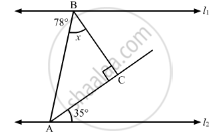
In the given figure, for which value of x is l1 || l2?
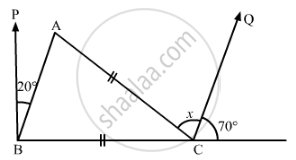
In the given figure, if BP || CQ and AC = BC, then the measure of x is
The base BC of triangle ABC is produced both ways and the measure of exterior angles formed are 94° and 126°. Then, ∠BAC =
If the bisectors of the acute angles of a right triangle meet at O, then the angle at Obetween the two bisectors is
In a ΔABC, ∠A = 50° and BC is produced to a point D. If the bisectors of ∠ABC and ∠ACDmeet at E, then ∠E =
Which of the following correctly describes the given triangle?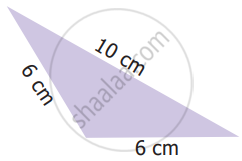
In ∆ABC, AB = AC and ∠B = 50°. Then ∠C is equal to ______.
Is it possible to construct a triangle with lengths of its sides as 8 cm, 7 cm and 4 cm? Give reason for your answer.
