Advertisements
Advertisements
Question
M is a point on side BC of a triangle ABC such that AM is the bisector of ∠BAC. Is it true to say that perimeter of the triangle is greater than 2 AM? Give reason for your answer.
Advertisements
Solution
Yes, In ΔABC, M is a point of side BC such that AM is the bisector of ∠BAC.
In ΔABM, AB + BM > AM ...(i) [Sum of two sides of a triangle is greater than the third side]
In ΔACM, AC + CM > AM ...(ii) [Sum of two sides of a triangle is greater than the third side]
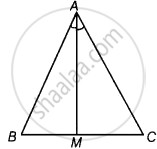
On adding equations (i) and (ii), we get
(AB + BM + AC + CM) > 2AM
⇒ (AB + BM + MC + AC) > 2AM
⇒ AB + BC + AC > 2AM ...[∵ BC = BM + MC]
∴ Perimeter of ΔABC > 2AM
APPEARS IN
RELATED QUESTIONS
In a ΔABC, if ∠A=l20° and AB = AC. Find ∠B and ∠C.
Find the measure of each exterior angle of an equilateral triangle.
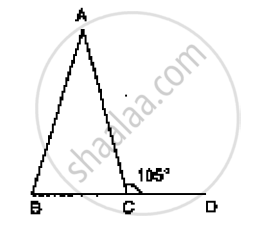
In Figure 10.24, AB = AC and ∠ACD =105°, find ∠BAC.
P is a point on the bisector of an angle ∠ABC. If the line through P parallel to AB meets BC at Q, prove that triangle BPQ is isosceles.
Fill the blank in the following so that the following statement is true.
In a ΔABC if ∠A = ∠C , then AB = ......
In a ΔABC, if ∠B = ∠C = 45°, which is the longest side?
Which of the following statements are true (T) and which are false (F)?
If two angles of a triangle are unequal, then the greater angle has the larger side opposite to it.
Fill in the blank to make the following statement true.
In a right triangle the hypotenuse is the .... side.
Fill in the blank to make the following statement true.
If two sides of a triangle are unequal, then the larger side has .... angle opposite to it.
In the given figure, the sides BC, CA and AB of a Δ ABC have been produced to D, E and F respectively. If ∠ACD = 105° and ∠EAF = 45°, find all the angles of the Δ ABC.
Write the sum of the angles of an obtuse triangle.
Line segments AB and CD intersect at O such that AC || DB. If ∠CAB = 45° and ∠CDB = 55°, then ∠BOD =
In the given figure, if AB ⊥ BC. then x =
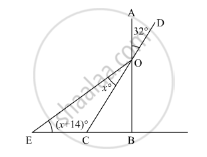
In the given figure, what is the value of x?
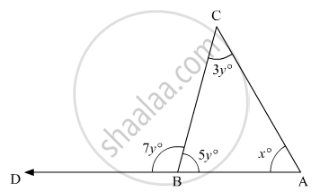
In the given figure, the value of x is ______.
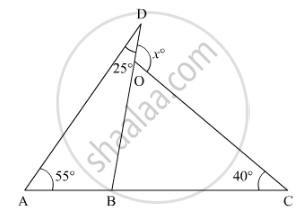
If the bisectors of the acute angles of a right triangle meet at O, then the angle at Obetween the two bisectors is
In ∆PQR, ∠R = ∠P and QR = 4 cm and PR = 5 cm. Then the length of PQ is ______.
D is a point on the side BC of a ∆ABC such that AD bisects ∠BAC. Then ______.
Find all the angles of an equilateral triangle.
