Advertisements
Advertisements
Question
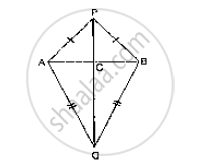
AB is a line seg P and Q are points on opposite sides of AB such that each of them is equidistant from the points A and B (See Fig. 10.26). Show that the line PQ is perpendicular bisector of AB.
Advertisements
Solution
Consider the figure,
We have
AB is a line segment and P,Q are points on opposite sides of AB such that
AP = BP .......(1)
AQ = BQ ........(2)
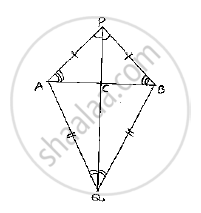
We have to prove that PQ is perpendicular bisector of AB. Now consider DPAQ and DPBQ,
We have AP = BP [∵ From (1)]
AQ = BQ [∵ From (2)]
And PQ = PQ [Common site]
⇒∠PAQ ≅ ∠PBQ ..….(3) [From SSS congruence]
Now, we can observe that Δ𝐴𝑃𝐵 𝑎𝑛𝑑 Δ𝐴𝐵𝑄 are isosceles triangles.(From 1 and 2)
⟹∠𝑃𝐴𝐵 = ∠𝑃𝐵𝐴 𝑎𝑛𝑑 ∠𝑄𝐴𝐵 = ∠𝑄𝐵𝐴
Now consider ΔPAC and , ΔPBC
C is the point of intersection of AB and PQ.
PA = PB [from (1)]
∠APC = ∠BPC [from (2)]
PC = PC [Common side]
So, from SAS congruency of triangle ΔPAC ≅ ΔPBC
⇒AC = CB and∠PCA = ∠PCB …….(4)
[∵ Corresponding parts of congruent triangles are equal] And also, ACB is line segment
⇒∠ACP + ∠BCP = 180°
But ∠ACP =∠PCB
⇒∠ACP = ∠PCB = 90° ………(5)
We have AC = CB ⇒ C is the midpoint of AB
From (4) and (5)
We can conclude that PC is the perpendicular bisector of AB
Since C is a point on the line PQ, we can say that PQ is the perpendicular bisector of AB.
APPEARS IN
RELATED QUESTIONS
In a ΔABC, if ∠A=l20° and AB = AC. Find ∠B and ∠C.
In a ΔABC, if AB = AC and ∠B = 70°, find ∠A.
If the base of an isosceles triangle is produced on both sides, prove that the exterior angles so formed are equal to each other.
Angles A, B, C of a triangle ABC are equal to each other. Prove that ΔABC is equilateral.
ABC is a triangle in which ∠B = 2 ∠C. D is a point on BC such that AD bisects ∠BAC and AB = CD.
Prove that ∠BAC = 72°.
Which of the following statements are true (T) and which are false (F):
The measure of each angle of an equilateral triangle is 60°
Which of the following statements are true (T) and which are false (F):
The bisectors of two equal angles of a triangle are equal
Which of the following statements are true (T) and which are false (F):
The two altitudes corresponding to two equal sides of a triangle need not be equal.
O is any point in the interior of ΔABC. Prove that
(i) AB + AC > OB + OC
(ii) AB + BC + CA > OA + QB + OC
(iii) OA + OB + OC >` 1/2`(AB + BC + CA)
In the given figure, the sides BC, CA and AB of a Δ ABC have been produced to D, E and F respectively. If ∠ACD = 105° and ∠EAF = 45°, find all the angles of the Δ ABC.
In a triangle ABC, if AB = AC and AB is produced to D such that BD = BC, find ∠ACD: ∠ADC.
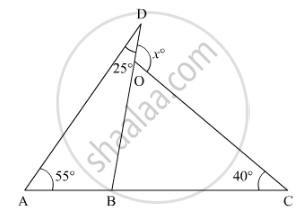
In the given figure, the value of x is ______.
The base BC of triangle ABC is produced both ways and the measure of exterior angles formed are 94° and 126°. Then, ∠BAC =
If the bisectors of the acute angles of a right triangle meet at O, then the angle at Obetween the two bisectors is
In ∆ABC, BC = AB and ∠B = 80°. Then ∠A is equal to ______.
In ∆PQR, ∠R = ∠P and QR = 4 cm and PR = 5 cm. Then the length of PQ is ______.
In ∆PQR, if ∠R > ∠Q, then ______.
Is it possible to construct a triangle with lengths of its sides as 8 cm, 7 cm and 4 cm? Give reason for your answer.
CDE is an equilateral triangle formed on a side CD of a square ABCD (Figure). Show that ∆ADE ≅ ∆BCE.

In a triangle ABC, D is the mid-point of side AC such that BD = `1/2` AC. Show that ∠ABC is a right angle.
