Advertisements
Advertisements
Question
P is a point on the bisector of an angle ∠ABC. If the line through P parallel to AB meets BC at Q, prove that triangle BPQ is isosceles.
Advertisements
Solution
Given that P is a point on the bisector of an angle ABC, and PQ|| AB.
We have to prove that ΔBPQis isosceles
Since,
BP is bisector of ∠ABC⇒∠ABP=∠PBC ............(1)
Now,
PQllAB
⇒ ∠BPQ=∠ABP ................(2)
[alternative angles]
From (1) and (2), we get
∠BPQ=∠PBC(or)∠BPQ=∠PBQ
Now,
In , ΔBPQ
∠BPQ=∠PBQ
⇒ΔBPQ is an isosceles triangle.
∴Hence proved
APPEARS IN
RELATED QUESTIONS
In an isosceles triangle ABC, with AB = AC, the bisectors of ∠B and ∠C intersect each other at O. Join A to O. Show that:
- OB = OC
- AO bisects ∠A
Prove that the medians of an equilateral triangle are equal.
In a ΔABC, if ∠A=l20° and AB = AC. Find ∠B and ∠C.
In a ΔABC, if AB = AC and ∠B = 70°, find ∠A.
In Figure 10.24, AB = AC and ∠ACD =105°, find ∠BAC.
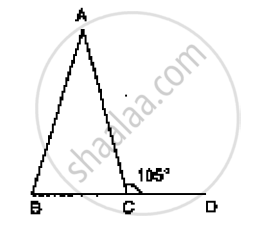
If the base of an isosceles triangle is produced on both sides, prove that the exterior angles so formed are equal to each other.
PQR is a triangle in which PQ = PR and S is any point on the side PQ. Through S, a line is drawn parallel to QR and intersecting PR at T. Prove that PS = PT.
Which of the following statements are true (T) and which are false (F):
The measure of each angle of an equilateral triangle is 60°
Which of the following statements are true (T) and which are false (F):
The bisectors of two equal angles of a triangle are equal
Fill the blank in the following so that the following statement is true.
Sides opposite to equal angles of a triangle are ......
Fill the blank in the following so that the following statement is true.
In right triangles ABC and DEF, if hypotenuse AB = EF and side AC = DE, then ΔABC ≅ Δ ……
In ΔABC, if ∠A = 40° and ∠B = 60°. Determine the longest and shortest sides of the triangle.
Which of the following statements are true (T) and which are false (F)?
Sum of the three sides of a triangle is less than the sum of its three altitudes.
Fill in the blank to make the following statement true.
In a right triangle the hypotenuse is the .... side.
Fill in the blank to make the following statement true.
The sum of any two sides of a triangle is .... than the third side.
In the given figure, if AB || DE and BD || FG such that ∠FGH = 125° and ∠B = 55°, find x and y.
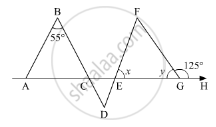
In the given figure, x + y =
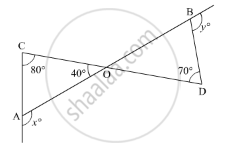
In the given figure, what is z in terms of x and y?
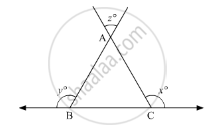
Two sides of a triangle are of lengths 5 cm and 1.5 cm. The length of the third side of the triangle cannot be ______.
Show that in a quadrilateral ABCD, AB + BC + CD + DA < 2(BD + AC)
