Advertisements
Advertisements
Question
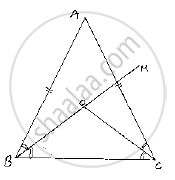
In a ΔABC, it is given that AB = AC and the bisectors of ∠B and ∠C intersect at O. If M is a point on BO produced, prove that ∠MOC = ∠ABC.
Advertisements
Solution
Given that in , ΔABC,
AB=AC and the bisector of ∠B and ∠C intersect at O and M is
a point on BO produced
We have to prove ∠ MOC=∠ABC
Since,
AB =AC ⇒ΔABC is isosceles ⇒ ∠B=∠C(or) ∠ABC=∠ACB
Now,
BO and CO are bisectors of ∠ABC and ∠ACB respectively
⇒ABO=∠OBC=∠ACO=∠OB=`1/2` ∠ABC=`1/2`∠ACB ............(1)
We have, in ΔOBC
∠OBC +∠OCB +∠BOC =180° .............(2)
And also
∠BOC +∠COM =180° ..................(3)[Straight angle]
Equating (2) and (3)
⇒ ∠OBC+∠OCB+-∠BOC=∠BOC+∠MOC
⇒ ∠OBC+∠OBC=∠MOC [∵ from (1)]
⇒ 2∠OBBC=∠MOC
⇒2`(1/2∠ABC)`=∠MOC [∵from (1)]
⇒ ∠ABC=∠MOC
∴ ∠MOC=∠ABC
APPEARS IN
RELATED QUESTIONS
Prove that the medians of an equilateral triangle are equal.
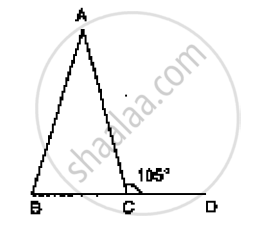
In Figure 10.24, AB = AC and ∠ACD =105°, find ∠BAC.
In an isosceles triangle, if the vertex angle is twice the sum of the base angles, calculate the angles of the triangle.
PQR is a triangle in which PQ = PR and S is any point on the side PQ. Through S, a line is drawn parallel to QR and intersecting PR at T. Prove that PS = PT.
P is a point on the bisector of an angle ∠ABC. If the line through P parallel to AB meets BC at Q, prove that triangle BPQ is isosceles.
Prove that each angle of an equilateral triangle is 60°.
In a ΔPQR, if PQ = QR and L, M and N are the mid-points of the sides PQ, QR and RP
respectively. Prove that LN = MN.
Which of the following statements are true (T) and which are false (F):
Sides opposite to equal angles of a triangle may be unequal
Which of the following statements are true (T) and which are false (F) :
If the altitude from one vertex of a triangle bisects the opposite side, then the triangle may be isosceles.
Which of the following statements are true (T) and which are false (F):
The bisectors of two equal angles of a triangle are equal
Fill the blank in the following so that the following statement is true.
Sides opposite to equal angles of a triangle are ......
Fill the blank in the following so that the following statement is true.
In an isosceles triangle ABC with AB = AC, if BD and CE are its altitudes, then BD is …… CE.
In ΔABC, if ∠A = 40° and ∠B = 60°. Determine the longest and shortest sides of the triangle.
Fill in the blank to make the following statement true.
The sum of three altitudes of a triangle is ..... than its perimeter.
ABC is a triangle. The bisector of the exterior angle at B and the bisector of ∠C intersect each other at D. Prove that ∠D = \[\frac{1}{2}\] ∠A.
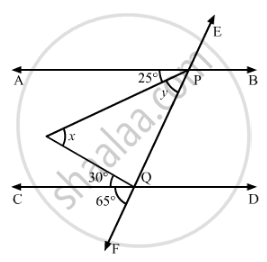
In the given figure, AB and CD are parallel lines and transversal EF intersects them at Pand Q respectively. If ∠APR = 25°, ∠RQC = 30° and ∠CQF = 65°, then
D is a point on the side BC of a ∆ABC such that AD bisects ∠BAC. Then ______.
AD is a median of the triangle ABC. Is it true that AB + BC + CA > 2AD? Give reason for your answer.
