Advertisements
Advertisements
Question
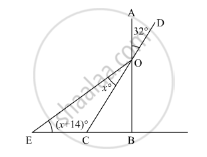
In the given figure, if l1 || l2, the value of x is
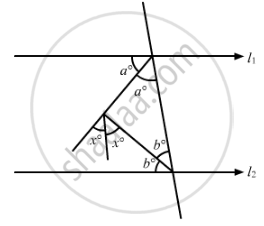
Options
\[22\frac{1}{2}\]
30
45
60
Advertisements
Solution
In the given problem, l1 || l2
We need to find the value of x
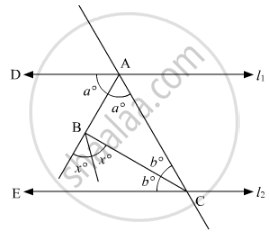
Here, as l1 || l2 , using the property, “consecutive interior angles are supplementary”, we get
∠DAC + ∠ECA = 180°
a + a+ b+ b =180°
2a + 2b = 180°
`a + b = (180°)/2`
a + b = 90° ..........(1)
Further, applying angle sum property of the triangle
In ΔABC
∠BAC + ∠BCA + ∠ABC =180°
a + b + ∠ABC = 180°
90 + ∠ABC = 180° (using 1)
∠ABC = 180° - 90°
∠ABC = 90°
Now, AB is a straight line, so using the property, “angles forming a linear pair are supplementary”, we get,
x + x + ∠ABC = 180°
2x + 90° = 180°
2x = 180° - 90°
`x = (90°)/2`
x = 45°
Thus, x = 45°
APPEARS IN
RELATED QUESTIONS
In an isosceles triangle ABC, with AB = AC, the bisectors of ∠B and ∠C intersect each other at O. Join A to O. Show that:
- OB = OC
- AO bisects ∠A
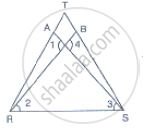
In Fig. 10.40, it is given that RT = TS, ∠1 = 2∠2 and ∠4 = 2∠3. Prove that ΔRBT ≅ ΔSAT
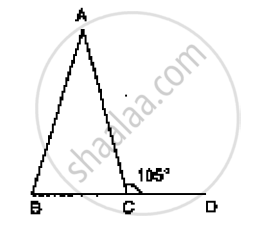
In Figure 10.24, AB = AC and ∠ACD =105°, find ∠BAC.
ABC is a triangle in which ∠B = 2 ∠C. D is a point on BC such that AD bisects ∠BAC and AB = CD.
Prove that ∠BAC = 72°.
Fill the blank in the following so that the following statement is true.
Angle opposite to equal sides of a triangle are .....
Is it possible to draw a triangle with sides of length 2 cm, 3 cm and 7 cm?
Which of the following statements are true (T) and which are false (F)?
Sum of the three sides of a triangle is less than the sum of its three altitudes.
Fill in the blank to make the following statement true.
The sum of any two sides of a triangle is .... than the third side.
Fill in the blank to make the following statement true.
If two angles of a triangle are unequal, then the smaller angle has the........ side opposite to it.
ABC is a triangle. The bisector of the exterior angle at B and the bisector of ∠C intersect each other at D. Prove that ∠D = \[\frac{1}{2}\] ∠A.
If the angles of a triangle are in the ratio 2 : 1 : 3, then find the measure of smallest angle.
In a ΔABC, if ∠A = 60°, ∠B = 80° and the bisectors of ∠B and ∠C meet at O, then ∠BOC =
In the given figure, if EC || AB, ∠ECD = 70° and ∠BDO = 20°, then ∠OBD is
In the given figure, if AB ⊥ BC. then x =
The side BC of ΔABC is produced to a point D. The bisector of ∠A meets side BC in L. If ∠ABC = 30° and ∠ACD = 115°, then ∠ALC = ______.
In ∆ABC, BC = AB and ∠B = 80°. Then ∠A is equal to ______.
If ∆PQR ≅ ∆EDF, then is it true to say that PR = EF? Give reason for your answer
M is a point on side BC of a triangle ABC such that AM is the bisector of ∠BAC. Is it true to say that perimeter of the triangle is greater than 2 AM? Give reason for your answer.
Bisectors of the angles B and C of an isosceles triangle ABC with AB = AC intersect each other at O. Show that external angle adjacent to ∠ABC is equal to ∠BOC
