Advertisements
Advertisements
Question
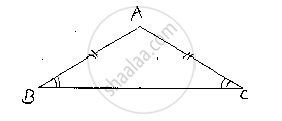
In an isosceles triangle, if the vertex angle is twice the sum of the base angles, calculate the angles of the triangle.
Advertisements
Solution
Let ΔABC be isosceles such that AB = AC
⇒∠B=∠C
Given that vertex angle A is twice the sum of the base angles B and C.
i.e., ∠A=2(∠B+∠C)
⇒∠A=2(∠B+∠B) [∵∠B=∠C]
⇒∠A=2(2∠B)
⇒∠A=4∠B
Now,
We know that sum of angles in a triangle 180°
⇒ ∠A+ ∠B+ ∠C=180°
4∠B+∠B+∠B=180° [∵∠A=4∠B and ∠B=∠C]
6∠B=180°
`∠B=(180°) /6=30° ` ∠B=30°
Since, ∠B=∠C⇒ ∠B=∠C=30°
And` ∠A=4∠B⇒ ∠A=4xx30°=120° `
∴Angles of the given triangle are 120°,30°,30°
APPEARS IN
RELATED QUESTIONS
Two lines AB and CD intersect at O such that BC is equal and parallel to AD. Prove that the lines AB and CD bisect at O.
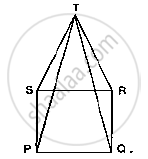
In Fig. 10.23, PQRS is a square and SRT is an equilateral triangle. Prove that
(i) PT = QT (ii) ∠TQR = 15°
In a ΔABC, if ∠A=l20° and AB = AC. Find ∠B and ∠C.
In a ΔABC, if AB = AC and ∠B = 70°, find ∠A.
BD and CE are bisectors of ∠B and ∠C of an isosceles ΔABC with AB = AC. Prove that BD = CE.
ABC is a triangle in which ∠B = 2 ∠C. D is a point on BC such that AD bisects ∠BAC and AB = CD.
Prove that ∠BAC = 72°.
ABC is a right angled triangle in which ∠A = 90° and AB = AC. Find ∠B and ∠C.
Which of the following statements are true (T) and which are false (F):
If the bisector of the vertical angle of a triangle bisects the base, then the triangle may be isosceles.
In a ΔABC, if ∠B = ∠C = 45°, which is the longest side?
In ΔABC, side AB is produced to D so that BD = BC. If ∠B = 60° and ∠A = 70°, prove that: (i) AD > CD (ii) AD > AC
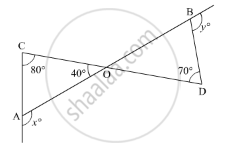
Line segments AB and CD intersect at O such that AC || DB. If ∠CAB = 45° and ∠CDB = 55°, then ∠BOD =
In the given figure, x + y =
If the measures of angles of a triangle are in the ratio of 3 : 4 : 5, what is the measure of the smallest angle of the triangle?
In the given figure, what is the value of x?
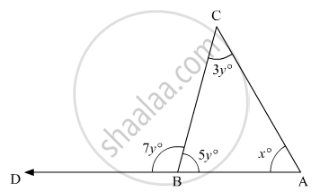
In the given figure, the value of x is ______.
The base BC of triangle ABC is produced both ways and the measure of exterior angles formed are 94° and 126°. Then, ∠BAC =
In a ΔABC, ∠A = 50° and BC is produced to a point D. If the bisectors of ∠ABC and ∠ACDmeet at E, then ∠E =
The angles of a right angled triangle are
D is a point on the side BC of a ∆ABC such that AD bisects ∠BAC. Then ______.
