Advertisements
Advertisements
Question
In the given figure, what is z in terms of x and y?
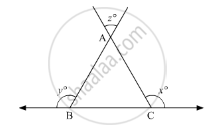
Options
x + y + 180
x + y − 180
180° − (x + y)
x + y + 360°
Advertisements
Solution
In the given ΔABC, we need to convert z in terms of x and y
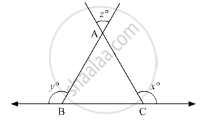
Now, BC is a straight line, so using the property, “angles forming a linear pair are supplementary”
∠ABC + y = 180
∠ABC =180° - y°
Similarly,
∠ACB + x° = 180°
∠ACB = 180° - x
Also, using the property, “vertically opposite angles are equal”, we get,
z = ∠BAC
Further, using angle sum property of the triangle
∠BAC + ∠ABC + ∠ACB = 180°
z° + (180°- y°) + (180° - x°) = 180°
360° + z° - y° - x° = 180°
180° + z° = y° + x°
z° = y°+ x° -180°
Thus, z = y + x -180°
APPEARS IN
RELATED QUESTIONS
Show that the angles of an equilateral triangle are 60° each.
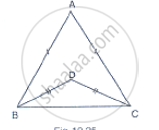
In figure, AB = AC and DB = DC, find the ratio ∠ABD : ∠ACD
In a ΔABC, it is given that AB = AC and the bisectors of ∠B and ∠C intersect at O. If M is a point on BO produced, prove that ∠MOC = ∠ABC.
ABC is a right angled triangle in which ∠A = 90° and AB = AC. Find ∠B and ∠C.
Fill the blank in the following so that the following statement is true.
In an isosceles triangle ABC with AB = AC, if BD and CE are its altitudes, then BD is …… CE.
Is it possible to draw a triangle with sides of length 2 cm, 3 cm and 7 cm?
Which of the following statements are true (T) and which are false (F)?
Sum of the three sides of a triangle is less than the sum of its three altitudes.
Which of the following statements are true (T) and which are false (F)?
Sum of any two sides of a triangle is greater than the third side.
Which of the following statements are true (T) and which are false (F)?
If two angles of a triangle are unequal, then the greater angle has the larger side opposite to it.
Fill in the blank to make the following statement true.
In a right triangle the hypotenuse is the .... side.
Fill in the blank to make the following statement true.
The sum of any two sides of a triangle is .... than the third side.
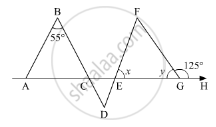
In the given figure, if AB || DE and BD || FG such that ∠FGH = 125° and ∠B = 55°, find x and y.
In a triangle ABC, if AB = AC and AB is produced to D such that BD = BC, find ∠ACD: ∠ADC.
In the given figure, what is the value of x?
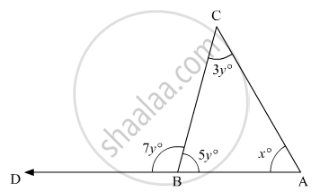
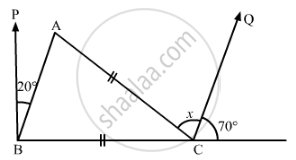
In the given figure, if BP || CQ and AC = BC, then the measure of x is
The angles of a right angled triangle are
If ∆PQR ≅ ∆EDF, then is it true to say that PR = EF? Give reason for your answer
M is a point on side BC of a triangle ABC such that AM is the bisector of ∠BAC. Is it true to say that perimeter of the triangle is greater than 2 AM? Give reason for your answer.
Is it possible to construct a triangle with lengths of its sides as 8 cm, 7 cm and 4 cm? Give reason for your answer.
Find all the angles of an equilateral triangle.
