Advertisements
Advertisements
Question
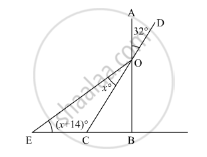
In the given figure, if AB ⊥ BC. then x =
Options
18
22
25
32
Advertisements
Solution
In the given figure, AB ⊥ BC
We need to find the value of x.
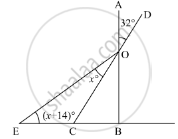
Now, since AB and CD are straight lines intersecting at point O, using the property, “vertically opposite angles are equal”, we get,
∠BOC = ∠AOD
∠BOC = 32°
Further, applying angle sum property of the triangle
In ΔBOC
∠BOC + ∠OBC + ∠BCO = 180°
32° + 90° + ∠BCO = 180°
∠BCO = 180° -122°
∠BCO = 58°
Then, using the property, “an exterior angle of the triangle is equal to the sum of the two opposite interior angles”, we get,
In ΔEOC
∠BCO = ∠OEC +∠EOC
58° = (x + 14)° + x
58° = 2x + 14°
2x = 58° - 14°
Further solving for x, we get,
2x = 44°
`x = (44° )/2`
x = 22°
Thus x = 22°
APPEARS IN
RELATED QUESTIONS
Find the measure of each exterior angle of an equilateral triangle.
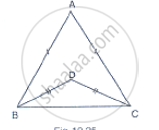
In figure, AB = AC and DB = DC, find the ratio ∠ABD : ∠ACD
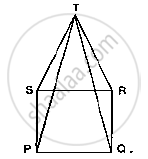
In Fig. 10.23, PQRS is a square and SRT is an equilateral triangle. Prove that
(i) PT = QT (ii) ∠TQR = 15°
In a ΔABC, if ∠A=l20° and AB = AC. Find ∠B and ∠C.
Find the measure of each exterior angle of an equilateral triangle.
If the base of an isosceles triangle is produced on both sides, prove that the exterior angles so formed are equal to each other.
In a ΔPQR, if PQ = QR and L, M and N are the mid-points of the sides PQ, QR and RP
respectively. Prove that LN = MN.
ABC is a triangle and D is the mid-point of BC. The perpendiculars from D to AB and AC are equal. Prove that the triangle is isosceles.
Which of the following statements are true (T) and which are false (F):
Sides opposite to equal angles of a triangle may be unequal
Which of the following statements are true (T) and which are false (F) :
If the altitude from one vertex of a triangle bisects the opposite side, then the triangle may be isosceles.
Fill the blank in the following so that the following statement is true.
If altitudes CE and BF of a triangle ABC are equal, then AB = ....
In a ΔABC, if ∠B = ∠C = 45°, which is the longest side?
Prove that the perimeter of a triangle is greater than the sum of its altitudes.
Line segments AB and CD intersect at O such that AC || DB. If ∠CAB = 45° and ∠CDB = 55°, then ∠BOD =
If the measures of angles of a triangle are in the ratio of 3 : 4 : 5, what is the measure of the smallest angle of the triangle?
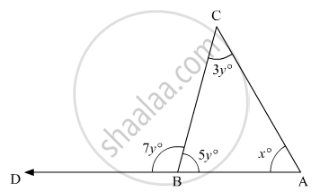
In the given figure, what is the value of x?
Which of the following correctly describes the given triangle?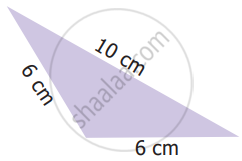
CDE is an equilateral triangle formed on a side CD of a square ABCD (Figure). Show that ∆ADE ≅ ∆BCE.

Find all the angles of an equilateral triangle.
