Advertisements
Advertisements
प्रश्न
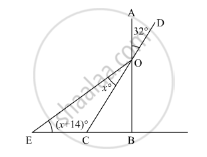
In the given figure, if AB ⊥ BC. then x =
विकल्प
18
22
25
32
Advertisements
उत्तर
In the given figure, AB ⊥ BC
We need to find the value of x.
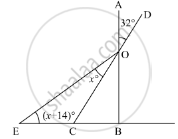
Now, since AB and CD are straight lines intersecting at point O, using the property, “vertically opposite angles are equal”, we get,
∠BOC = ∠AOD
∠BOC = 32°
Further, applying angle sum property of the triangle
In ΔBOC
∠BOC + ∠OBC + ∠BCO = 180°
32° + 90° + ∠BCO = 180°
∠BCO = 180° -122°
∠BCO = 58°
Then, using the property, “an exterior angle of the triangle is equal to the sum of the two opposite interior angles”, we get,
In ΔEOC
∠BCO = ∠OEC +∠EOC
58° = (x + 14)° + x
58° = 2x + 14°
2x = 58° - 14°
Further solving for x, we get,
2x = 44°
`x = (44° )/2`
x = 22°
Thus x = 22°
APPEARS IN
संबंधित प्रश्न
In ΔABC, AD is the perpendicular bisector of BC (see the given figure). Show that ΔABC is an isosceles triangle in which AB = AC.

ABC and DBC are two isosceles triangles on the same base BC (see the given figure). Show that ∠ABD = ∠ACD.
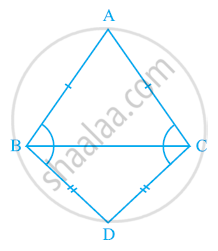
In figure, AB = AC and DB = DC, find the ratio ∠ABD : ∠ACD
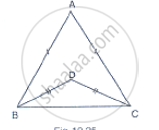
In a ΔABC, if AB = AC and ∠B = 70°, find ∠A.
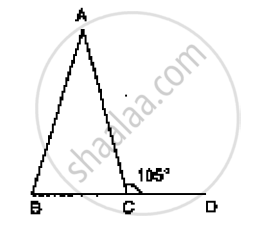
In Figure 10.24, AB = AC and ∠ACD =105°, find ∠BAC.
Two lines AB and CD intersect at O such that BC is equal and parallel to AD. Prove that the lines AB and CD bisect at O.
P is a point on the bisector of an angle ∠ABC. If the line through P parallel to AB meets BC at Q, prove that triangle BPQ is isosceles.
Which of the following statements are true (T) and which are false (F) :
If the altitude from one vertex of a triangle bisects the opposite side, then the triangle may be isosceles.
O is any point in the interior of ΔABC. Prove that
(i) AB + AC > OB + OC
(ii) AB + BC + CA > OA + QB + OC
(iii) OA + OB + OC >` 1/2`(AB + BC + CA)
Which of the following statements are true (T) and which are false (F)?
Of all the line segments that can be drawn from a point to a line not containing it, the perpendicular line segment is the shortest one.
Fill in the blank to make the following statement true.
Difference of any two sides of a triangle is........ than the third side.
Fill in the blank to make the following statement true.
If two sides of a triangle are unequal, then the larger side has .... angle opposite to it.
In the given figure, the sides BC, CA and AB of a Δ ABC have been produced to D, E and F respectively. If ∠ACD = 105° and ∠EAF = 45°, find all the angles of the Δ ABC.
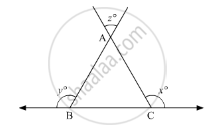
In the given figure, what is z in terms of x and y?
In ∆PQR, ∠P = 70° and ∠R = 30°. Which side of this triangle is the longest? Give reason for your answer.
In the following figure, D and E are points on side BC of a ∆ABC such that BD = CE and AD = AE. Show that ∆ABD ≅ ∆ACE.

CDE is an equilateral triangle formed on a side CD of a square ABCD (Figure). Show that ∆ADE ≅ ∆BCE.

