Advertisements
Advertisements
प्रश्न
ABC is a triangle in which ∠B = 2 ∠C. D is a point on BC such that AD bisects ∠BAC and AB = CD.
Prove that ∠BAC = 72°.
Advertisements
उत्तर

In ΔABC,
∠B = 2∠C or, ∠B = 2y, where ∠C = y.
AD is the bisector of ∠BAC.
So, let ∠BAD = ∠CAD = x.
Let BP be the bisector of ∠ABC. Join PD.
In ΔBPC, we have
∠CBP = ∠BCP = y ⇒ BP = PC
In Δ′s ABP and DCP, we have
∠ABP = ∠DCP,
∠ABP = ∠DCP = y
BP = PC ........(As proved above)
∠ADC = ∠ABD + ∠BAD
⇒ x + 2x = 2y + x
⇒ x = y
APPEARS IN
संबंधित प्रश्न
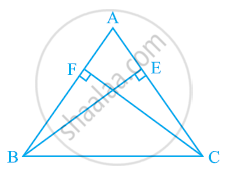
ABC is a triangle in which altitudes BE and CF to sides AC and AB are equal (see the given figure). Show that
- ΔABE ≅ ΔACF
- AB = AC, i.e., ABC is an isosceles triangle.
ΔABC is an isosceles triangle in which AB = AC. Side BA is produced to D such that AD = AB (see the given figure). Show that ∠BCD is a right angle.

Determine the measure of each of the equal angles of a right-angled isosceles triangle.
In a ΔABC, if AB = AC and ∠B = 70°, find ∠A.
The vertical angle of an isosceles triangle is 100°. Find its base angles.
Find the measure of each exterior angle of an equilateral triangle.
Angles A, B, C of a triangle ABC are equal to each other. Prove that ΔABC is equilateral.
In a ΔPQR, if PQ = QR and L, M and N are the mid-points of the sides PQ, QR and RP
respectively. Prove that LN = MN.
ABC is a triangle in which BE and CF are, respectively, the perpendiculars to the sides AC and AB. If BE = CF, prove that ΔABC is isosceles
In a ΔABC, if ∠B = ∠C = 45°, which is the longest side?
In ΔABC, if ∠A = 40° and ∠B = 60°. Determine the longest and shortest sides of the triangle.
Is it possible to draw a triangle with sides of length 2 cm, 3 cm and 7 cm?
O is any point in the interior of ΔABC. Prove that
(i) AB + AC > OB + OC
(ii) AB + BC + CA > OA + QB + OC
(iii) OA + OB + OC >` 1/2`(AB + BC + CA)
Prove that the perimeter of a triangle is greater than the sum of its altitudes.
In the given figure, the sides BC, CA and AB of a Δ ABC have been produced to D, E and F respectively. If ∠ACD = 105° and ∠EAF = 45°, find all the angles of the Δ ABC.
ABC is a triangle. The bisector of the exterior angle at B and the bisector of ∠C intersect each other at D. Prove that ∠D = \[\frac{1}{2}\] ∠A.
If the bisectors of the acute angles of a right triangle meet at O, then the angle at Obetween the two bisectors is
Which of the following correctly describes the given triangle?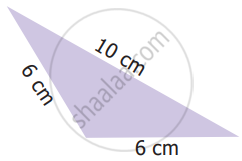
Show that in a quadrilateral ABCD, AB + BC + CD + DA > AC + BD
