Advertisements
Advertisements
Question
If the measures of angles of a triangle are in the ratio of 3 : 4 : 5, what is the measure of the smallest angle of the triangle?
Options
25°
30°
45°
60°
Advertisements
Solution
In the given figure, measures of the angles of ΔABC are in the ratio 3 : 4 : 5. We need to find the measure of the smallest angle of the triangle.
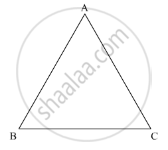
Let us take,
∠A = 3x
∠B = 4x
∠C = 5x
Now, applying angle sum property of the triangle in ΔABC, we get,
∠A + ∠B + ∠C = 180°
3x + 4x + 5x = 180°
12X = 180°
`x = (180°)/ 12`
x = 15°
Substituting the value of x in ,∠A,∠Band∠C
∠A = 3(15°) = 45
∠B = 4(15V) = 60
∠C = 5(15°) = 75°
Since, the measure of ∠A is the smallest
Thus, the measure of the smallest angle of the triangle is 45°
APPEARS IN
RELATED QUESTIONS
ABC is an isosceles triangle in which altitudes BE and CF are drawn to equal sides AC and AB respectively (see the given figure). Show that these altitudes are equal.

BD and CE are bisectors of ∠B and ∠C of an isosceles ΔABC with AB = AC. Prove that BD = CE.
ABC is a right angled triangle in which ∠A = 90° and AB = AC. Find ∠B and ∠C.
ABC is a triangle and D is the mid-point of BC. The perpendiculars from D to AB and AC are equal. Prove that the triangle is isosceles.
Fill the blank in the following so that the following statement is true.
Sides opposite to equal angles of a triangle are ......
In ΔABC, side AB is produced to D so that BD = BC. If ∠B = 60° and ∠A = 70°, prove that: (i) AD > CD (ii) AD > AC
Prove that the perimeter of a triangle is greater than the sum of its altitudes.
Which of the following statements are true (T) and which are false (F)?
Sum of the three sides of a triangle is less than the sum of its three altitudes.
Which of the following statements are true (T) and which are false (F)?
Sum of any two sides of a triangle is greater than the third side.
Fill in the blank to make the following statement true.
The sum of any two sides of a triangle is .... than the third side.
Fill in the blank to make the following statement true.
If two sides of a triangle are unequal, then the larger side has .... angle opposite to it.
In a triangle ABC, if AB = AC and AB is produced to D such that BD = BC, find ∠ACD: ∠ADC.
In ΔABC, if ∠A = 100°, AD bisects ∠A and AD ⊥ BC. Then, ∠B =
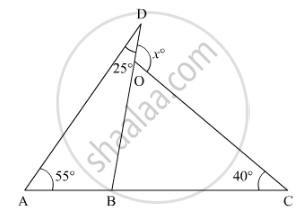
In the given figure, the value of x is ______.
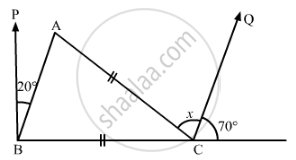
In the given figure, if BP || CQ and AC = BC, then the measure of x is
In the following figure, D and E are points on side BC of a ∆ABC such that BD = CE and AD = AE. Show that ∆ABD ≅ ∆ACE.

CDE is an equilateral triangle formed on a side CD of a square ABCD (Figure). Show that ∆ADE ≅ ∆BCE.

