Advertisements
Advertisements
Question
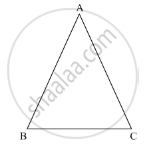
If the angles A, B and C of ΔABC satisfy the relation B − A = C − B, then find the measure of ∠B.
Advertisements
Solution
In the given ΔABC,
∠A, ∠B and ∠C satisfy the relation B - A = C - B
We need to fine the measure of ∠B.
As,
B - A = C - B
B + B = C + A
2B = C + A
2B - A = C ........(1)
Now, using the angle sum property of the triangle, we get,
A + B + C = 180°
2B - A + A +B = 180° (Using 1)
3B = 180°
`B = (180°) / 3`
= 60°
Therefore, ∠B = 60°
APPEARS IN
RELATED QUESTIONS
ΔABC is an isosceles triangle in which AB = AC. Side BA is produced to D such that AD = AB (see the given figure). Show that ∠BCD is a right angle.

In a ΔABC, if ∠A=l20° and AB = AC. Find ∠B and ∠C.
In a ΔPQR, if PQ = QR and L, M and N are the mid-points of the sides PQ, QR and RP
respectively. Prove that LN = MN.
Which of the following statements are true (T) and which are false (F):
Angles opposite to equal sides of a triangle are equal
Which of the following statements are true (T) and which are false (F) :
If the altitude from one vertex of a triangle bisects the opposite side, then the triangle may be isosceles.
Which of the following statements are true (T) and which are false (F):
The bisectors of two equal angles of a triangle are equal
Which of the following statements are true (T) and which are false (F):
If the bisector of the vertical angle of a triangle bisects the base, then the triangle may be isosceles.
Fill the blank in the following so that the following statement is true.
In an isosceles triangle ABC with AB = AC, if BD and CE are its altitudes, then BD is …… CE.
Which of the following statements are true (T) and which are false (F)?
Sum of any two sides of a triangle is greater than the third side.
Which of the following statements are true (T) and which are false (F)?
Difference of any two sides of a triangle is equal to the third side.
In the given figure, the sides BC, CA and AB of a Δ ABC have been produced to D, E and F respectively. If ∠ACD = 105° and ∠EAF = 45°, find all the angles of the Δ ABC.
If the angles of a triangle are in the ratio 2 : 1 : 3, then find the measure of smallest angle.
If the measures of angles of a triangle are in the ratio of 3 : 4 : 5, what is the measure of the smallest angle of the triangle?
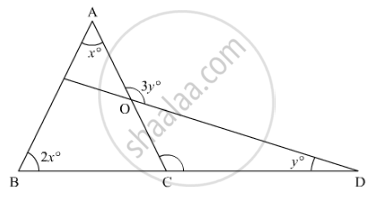
In the given figure, what is y in terms of x?
If the bisectors of the acute angles of a right triangle meet at O, then the angle at Obetween the two bisectors is
In ∆ABC, BC = AB and ∠B = 80°. Then ∠A is equal to ______.
In triangles ABC and PQR, AB = AC, ∠C = ∠P and ∠B = ∠Q. The two triangles are ______.
In ∆PQR, ∠P = 70° and ∠R = 30°. Which side of this triangle is the longest? Give reason for your answer.
M is a point on side BC of a triangle ABC such that AM is the bisector of ∠BAC. Is it true to say that perimeter of the triangle is greater than 2 AM? Give reason for your answer.
