Advertisements
Advertisements
Question
In the given figure, what is y in terms of x?
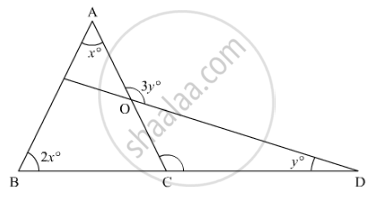
Options
- \[\frac{3}{2}x\]
- \[\frac{4}{3}x\]
- x
\[\frac{3}{4}x\]
Advertisements
Solution
In the given figure, we need to find y in terms of x
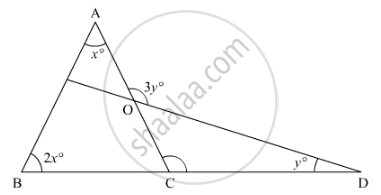
Now, using the property, “an exterior angle of the triangle is equal to the sum of the two opposite interior angles”, we get
In ΔABC
ext∠ACD = ∠CAB + ∠CBA
ext∠ACD = x + 2x
ext∠ACD =3x ..........(1)
Similarly, in ΔOCD
ext∠AOD = ∠OCD + ∠CDO
3y = ∠OCD + y (using 1)
3y - y = 3x
2y = 3x
`y = 3/2 x`
Thus, `y = 3/2x `
APPEARS IN
RELATED QUESTIONS
In ΔABC, AD is the perpendicular bisector of BC (see the given figure). Show that ΔABC is an isosceles triangle in which AB = AC.

Find the measure of each exterior angle of an equilateral triangle.
In a ΔABC, if ∠A=l20° and AB = AC. Find ∠B and ∠C.
Find the measure of each exterior angle of an equilateral triangle.
In an isosceles triangle, if the vertex angle is twice the sum of the base angles, calculate the angles of the triangle.
P is a point on the bisector of an angle ∠ABC. If the line through P parallel to AB meets BC at Q, prove that triangle BPQ is isosceles.
Fill the blank in the following so that the following statement is true.
Angle opposite to equal sides of a triangle are .....
In ΔABC, side AB is produced to D so that BD = BC. If ∠B = 60° and ∠A = 70°, prove that: (i) AD > CD (ii) AD > AC
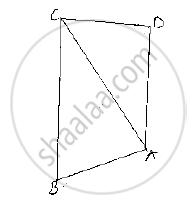
In Fig. 10.131, prove that: (i) CD + DA + AB + BC > 2AC (ii) CD + DA + AB > BC
Which of the following statements are true (T) and which are false (F)?
Difference of any two sides of a triangle is equal to the third side.
Fill in the blank to make the following statement true.
If two sides of a triangle are unequal, then the larger side has .... angle opposite to it.
ABC is a triangle. The bisector of the exterior angle at B and the bisector of ∠C intersect each other at D. Prove that ∠D = \[\frac{1}{2}\] ∠A.
Write the sum of the angles of an obtuse triangle.
If the angles of a triangle are in the ratio 2 : 1 : 3, then find the measure of smallest angle.
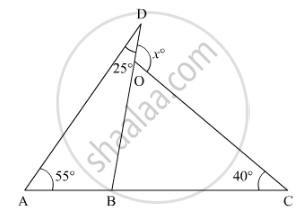
In the given figure, the value of x is ______.
The base BC of triangle ABC is produced both ways and the measure of exterior angles formed are 94° and 126°. Then, ∠BAC =
Which of the following correctly describes the given triangle?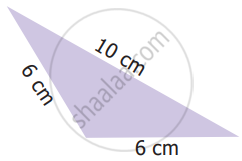
D is a point on the side BC of a ∆ABC such that AD bisects ∠BAC. Then ______.
ABC is an isosceles triangle with AB = AC and D is a point on BC such that AD ⊥ BC (Figure). To prove that ∠BAD = ∠CAD, a student proceeded as follows:
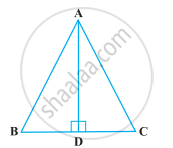
In ∆ABD and ∆ACD,
AB = AC (Given)
∠B = ∠C (Because AB = AC)
and ∠ADB = ∠ADC
Therefore, ∆ABD ≅ ∆ACD (AAS)
So, ∠BAD = ∠CAD (CPCT)
What is the defect in the above arguments?
[Hint: Recall how ∠B = ∠C is proved when AB = AC].
