Advertisements
Advertisements
Question
Show that in a quadrilateral ABCD, AB + BC + CD + DA < 2(BD + AC)
Advertisements
Solution
Given: ABCD is a quadrilateral.
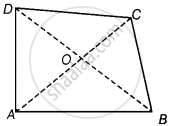
To show: AB + BC + CD + DA < 2(BD + AC)
Construction: Join diagonals AC and BD.
Proof: In ΔOAB, OA + OB > AB ...(i) [Sum of two sides of a triangle is greater than the third side]
In ΔOBC, OB + OC > BC ...(ii) [Sum of two sides of a triangle is greater than the third side]
In ΔOCD, OC + OD > CD ...(iii) [Sum of two sides of a triangle is greater than the third side]
In ΔODA, OD + OA > DA ...(iv) [Sum of two sides of a triangle is greater than the third side]
On adding equations (i), (ii), (iii) and (iv), we get
2[(OA + OB + OC + OD] > AB + BC + CD + DA
⇒ 2[(OA + OC) + (OB + OD)] > AB + BC + CD + DA
⇒ 2(AC + BD) > AB + BC + CD + DA ...[∵ OA + OC = AC and OB + OD = BD]
⇒ AB + BC + CD + DA < 2(BD + AC)
APPEARS IN
RELATED QUESTIONS
If the base of an isosceles triangle is produced on both sides, prove that the exterior angles so formed are equal to each other.
Prove that the medians of an equilateral triangle are equal.
In a ΔABC, if ∠A=l20° and AB = AC. Find ∠B and ∠C.
Find the measure of each exterior angle of an equilateral triangle.
Prove that each angle of an equilateral triangle is 60°.
ABC is a triangle in which ∠B = 2 ∠C. D is a point on BC such that AD bisects ∠BAC and AB = CD.
Prove that ∠BAC = 72°.
Fill the blank in the following so that the following statement is true.
In an isosceles triangle ABC with AB = AC, if BD and CE are its altitudes, then BD is …… CE.
Fill the blank in the following so that the following statement is true.
In right triangles ABC and DEF, if hypotenuse AB = EF and side AC = DE, then ΔABC ≅ Δ ……
Which of the following statements are true (T) and which are false (F)?
Sum of the three sides of a triangle is less than the sum of its three altitudes.
In the given figure, x + y =
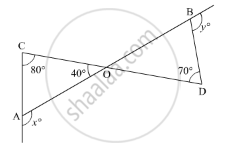
In the given figure, if AB ⊥ BC. then x =
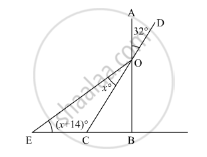
In the given figure, for which value of x is l1 || l2?
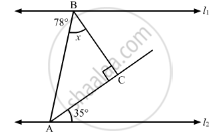
The side BC of ΔABC is produced to a point D. The bisector of ∠A meets side BC in L. If ∠ABC = 30° and ∠ACD = 115°, then ∠ALC = ______.
Two sides of a triangle are of lengths 5 cm and 1.5 cm. The length of the third side of the triangle cannot be ______.
In ∆PQR, if ∠R > ∠Q, then ______.
AD is a median of the triangle ABC. Is it true that AB + BC + CA > 2AD? Give reason for your answer.
Is it possible to construct a triangle with lengths of its sides as 8 cm, 7 cm and 4 cm? Give reason for your answer.
ABC is an isosceles triangle with AB = AC and D is a point on BC such that AD ⊥ BC (Figure). To prove that ∠BAD = ∠CAD, a student proceeded as follows:
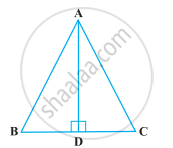
In ∆ABD and ∆ACD,
AB = AC (Given)
∠B = ∠C (Because AB = AC)
and ∠ADB = ∠ADC
Therefore, ∆ABD ≅ ∆ACD (AAS)
So, ∠BAD = ∠CAD (CPCT)
What is the defect in the above arguments?
[Hint: Recall how ∠B = ∠C is proved when AB = AC].
In a triangle ABC, D is the mid-point of side AC such that BD = `1/2` AC. Show that ∠ABC is a right angle.
