Advertisements
Advertisements
Question
If the bisector of the exterior vertical angle of a triangle be parallel to the base. Show that the triangle is isosce
Advertisements
Solution
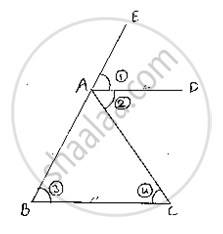
Given that the bisector of the exterior vertical angle of a triangle is parallel to the base and we have to prove that the triangle is isosceles
Let ABC be a triangle such that AD is the angular bisector of exterior vertical angle EAC and AD || BC
Let∠EAD = (1), ∠DAC = (2), ∠ABC = (3) and∠ACB = (4)
(1) = (2) [ ∵ AD is bisector of , ∠EAC ]
(1)=(3) [Corresponding angles]
and (2) = (4) [alternative angle]
⇒ (3) = (4) ⇒AB = AC
Since, in ΔABC, two sides AB and AC are equal we can say that
DABC is isosceles
APPEARS IN
RELATED QUESTIONS
Can a triangle have two obtuse angles? Justify your answer in case.
In Δ ABC, BD⊥ AC and CE ⊥ AB. If BD and CE intersect at O, prove that ∠BOC = 180° − A.
If one angle of a triangle is equal to the sum of the other two angles, then the triangle is
Find the unknown marked angles in the given figure:
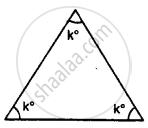
In the following, find the marked unknown angle:
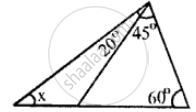
Find x, if the angles of a triangle is:
2x°, 4x°, 6x°
Classify the following triangle according to sides:
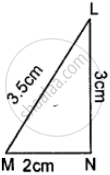
Classify the following triangle according to angle:

Match the following:
| Column A | Column B |
| (i) No sides are equal | Isosceles triangle |
| (ii) One right angle | Scalene triangle |
| (iii) One obtuse angle | Right angled triangle |
| (iv) Two sides of equal length | Equilateral triangle |
| (v) All sides are equal | Obtuse angled triangle |
Can we have two acute angles whose sum is a reflex angle? Why or why not?
