Advertisements
Advertisements
Question
Bisectors of the angles B and C of an isosceles triangle with AB = AC intersect each other at O. BO is produced to a point M. Prove that ∠MOC = ∠ABC.
Advertisements
Solution
Given in the question, bisectors of the angles B and C of an isosceles triangle ABC with AB = AC intersect each other at O. Now BO is produced to a point M.

In triangle ABC,
AB = AC
∠ABC = ∠ACB ...[Angle opposite to equal sides of a triangle are equal]
`1/2 ∠ABC = 1/2 ∠ACB`
That is ∠1 = ∠2 ...[Since, BO and CO are bisectors of ∠B and ∠C]
In triangle OBC,
Exterior ∠MOC = ∠1 + ∠2 ...[Exterior angle of a triangle is equal to the sum of interior opposite angles]
Exterior ∠MOC = 2∠1 ...[∠1 = ∠2]
Hence, ∠MOC = ∠ABC.
APPEARS IN
RELATED QUESTIONS
In a Δ ABC, AD bisects ∠A and ∠C > ∠B. Prove that ∠ADB > ∠ADC.
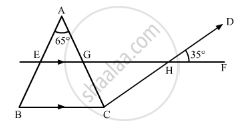
In the given figure, if AB || CD, EF || BC, ∠BAC = 65° and ∠DHF = 35°, find ∠AGH.
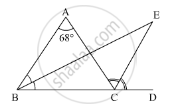
In the given figure, side BC of ΔABC is produced to point D such that bisectors of ∠ABC and ∠ACD meet at a point E. If ∠BAC = 68°, find ∠BEC.
In ΔPQR, If ∠R > ∠Q then ______.
State, if the triangle is possible with the following angles :
20°, 70°, and 90°
One angle of a triangle is 61° and the other two angles are in the ratio `1 1/2: 1 1/3`. Find these angles.
Can a triangle together have the following angles?
85°, 95° and 22°
The angles of the triangle are 3x – 40, x + 20 and 2x – 10 then the value of x is
The angles of a triangle are in the ratio 2 : 3 : 4. Then the angles are
In the following figure, AB = BC and AD = BD = DC. The number of isosceles triangles in the figure is ______.

