Advertisements
Advertisements
Question
In a ΔABC, ∠ABC = ∠ACB and the bisectors of ∠ABC and ∠ACB intersect at O such that ∠BOC = 120°. Show that ∠A = ∠B = ∠C = 60°.
Advertisements
Solution
Given,
In ΔABC
∠ABC=∠ ACB
Divide both sides by '2'
`1/2∠ABC=1/2∠ACB`
⇒ ∠OBC=∠ OCB [∵ OB, OC bisects ∠B and ∠C]
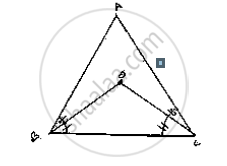
Now
`∠BOC=90^@+1/2∠A`
`120^@-90^@=1/2∠A`
`30^@xx(2)=∠A`
`∠A=60^@`
Now in Δ ABC
`∠A+∠ABC+∠ACB=180^@` (Sum of all angles of a triangle)
[∵∠ABC=∠ACB]
`60^@+2∠ABC=180^@`
`2∠ABC=180^@-60^2`
`∠ABC=120^@/2=90^@`
`∠ABC=∠ ACB`
`∴ ∠ACB=60^@`
Hence proved.
APPEARS IN
RELATED QUESTIONS
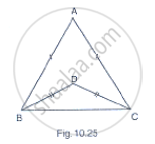
In Fig. 10.25, AB = AC and DB = DC, find the ratio ∠ABD : ∠ACD.
Is the following statement true and false :
If one angle of a triangle is obtuse, then it cannot be a right angled triangle.
One of the base angles of an isosceles triangle is 52°. Find its angle of the vertex.
Can a triangle together have the following angles?
33°, 74° and 73°
Classify the following triangle according to sides:

Classify the following triangle according to sides:
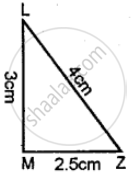
Classify the following triangle according to angle:

The length of the sides of the triangle is given. Say what types of triangles they are 3.4 cm, 3.4 cm, 5 cm.
P is a point on the bisector of ∠ABC. If the line through P, parallel to BA meet BC at Q, prove that BPQ is an isosceles triangle.
Can we have two acute angles whose sum is a right angle? Why or why not?
