Advertisements
Advertisements
Question
Can a triangle together have the following angles?
33°, 74° and 73°
Advertisements
Solution
Sum of all angles of a triangle = 180°
Here, 33°+ 74°+ 73°= 180°
∴ 180°= 180° Yes.
APPEARS IN
RELATED QUESTIONS
The angles of a triangle are (x − 40)°, (x − 20)° and `(1/2x-10)^@.` find the value of x
If the bisector of the exterior vertical angle of a triangle be parallel to the base. Show that the triangle is isosce
Is the following statement true and false :
An exterior angle of a triangle is equal to the sum of the two interior opposite angles.
Fill in the blank to make the following statement true:
An exterior angle of a triangle is always ......... than either of the interior opposite angles.
State exterior angle theorem.
State, if the triangle is possible with the following angles :
60°, 60°, and 50°
Classify the following triangle according to angle:
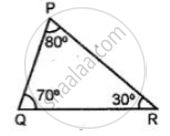
Classify the following triangle according to angle:
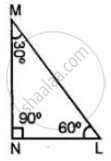
Q is a point on the side SR of a ∆PSR such that PQ = PR. Prove that PS > PQ.
How is a vertex of triangle △ABC most accurately defined?
