Advertisements
Advertisements
Question
If two acute angles of a right triangle are equal, then each acute is equal to
Options
30°
45°
60°
90°
Advertisements
Solution
In the given problem, we have a right angled triangle and the other two angles are equal.
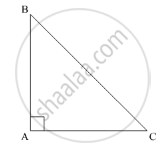
So, In ΔABC
∠A = 90°
∠B = ∠C
Now, using the angle sum property of the triangle, in ΔABC, we get,
∠A + ∠B + ∠C = 180°
90° + 2∠B = 180° (∠B = ∠C)
2∠B= 180° - 90°
`∠B = (90°)/2`
∠B = 45°
APPEARS IN
RELATED QUESTIONS
Can a triangle have two acute angles?Justify your answer in case.
The bisects of exterior angle at B and C of ΔABC meet at O. If ∠A = x°, then ∠BOC =
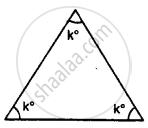
Find the unknown marked angles in the given figure:
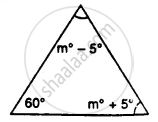
Find the unknown marked angles in the given figure:
Calculate the angles of a triangle if they are in the ratio 4: 5: 6.
One angle of a right-angled triangle is 70°. Find the other acute angle.
In ∆ABC, ∠A = ∠B = 62° ; find ∠C.
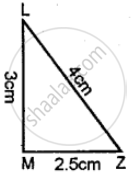
Classify the following triangle according to sides:
The length of the three segments is given for constructing a triangle. Say whether a triangle with these sides can be drawn. Give the reason for your answer.
12 cm, 12 cm, 16 cm
P is a point on the bisector of ∠ABC. If the line through P, parallel to BA meet BC at Q, prove that BPQ is an isosceles triangle.
