Advertisements
Advertisements
प्रश्न
If two acute angles of a right triangle are equal, then each acute is equal to
पर्याय
30°
45°
60°
90°
Advertisements
उत्तर
In the given problem, we have a right angled triangle and the other two angles are equal.
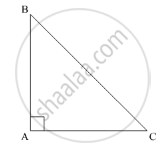
So, In ΔABC
∠A = 90°
∠B = ∠C
Now, using the angle sum property of the triangle, in ΔABC, we get,
∠A + ∠B + ∠C = 180°
90° + 2∠B = 180° (∠B = ∠C)
2∠B= 180° - 90°
`∠B = (90°)/2`
∠B = 45°
APPEARS IN
संबंधित प्रश्न
Can a triangle have two acute angles?Justify your answer in case.
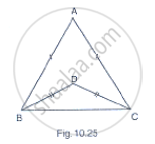
In Fig. 10.25, AB = AC and DB = DC, find the ratio ∠ABD : ∠ACD.
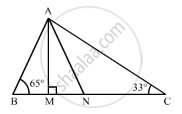
In the given figure, AM ⊥ BC and AN is the bisector of ∠A. If ∠B = 65° and ∠C = 33°, find ∠MAN.
State, if the triangle is possible with the following angles :
60°, 60°, and 50°
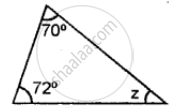
In the following, find the marked unknown angle:
Bisectors of the angles B and C of an isosceles triangle with AB = AC intersect each other at O. BO is produced to a point M. Prove that ∠MOC = ∠ABC.
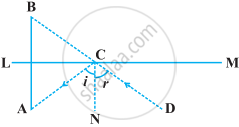
The image of an object placed at a point A before a plane mirror LM is seen at the point B by an observer at D as shown in the following figure. Prove that the image is as far behind the mirror as the object is in front of the mirror.
[Hint: CN is normal to the mirror. Also, angle of incidence = angle of reflection].
P is a point on the bisector of ∠ABC. If the line through P, parallel to BA meet BC at Q, prove that BPQ is an isosceles triangle.
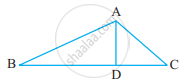
Which two triangles have ∠B in common?
What is the sum of the measures of the interior angles of any triangle, △ABC?
