Advertisements
Advertisements
प्रश्न
In a triangle, an exterior angle at a vertex is 95° and its one of the interior opposite angle is 55°, then the measure of the other interior angle is
पर्याय
55°
85°
40°
9.0°
Advertisements
उत्तर
In the given ΔABC, ∠DAC = 95° and ∠A = 55°

Now, according to the property, “exterior angle of a triangle is equal to the sum of two opposite interior angles”, we get,
∠A + ∠B = ∠ACD
55° + ∠B = 95°
∠B = 95° - 55°
= 40°
So, ∠B = 40°
APPEARS IN
संबंधित प्रश्न
Is the following statement true and false :
A triangle can have two right angles.
In ΔABC, if bisectors of ∠ABC and ∠ACB intersect at O at angle of 120°, then find the measure of ∠A.
An exterior angle of a triangle is equal to 100° and two interior opposite angles are equal. Each of these angles is equal to
If two sides of a triangle are 5 cm and 1.5 cm, the length of its third side cannot be ______.
One angle of a triangle is 60°. The other two angles are in the ratio of 5: 7. Find the two angles.
Classify the following triangle according to sides:
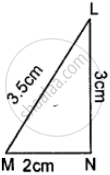
In the given figure, AB is parallel to CD. Then the value of b is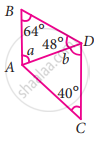
If an angle of a triangle is equal to the sum of the other two angles, find the type of the triangle
In the following figure, AB = BC and AD = BD = DC. The number of isosceles triangles in the figure is ______.

In the following figure, PQ ⊥ RQ, PQ = 5 cm and QR = 5 cm. Then ∆PQR is ______.

