Advertisements
Advertisements
प्रश्न
The bisects of exterior angle at B and C of ΔABC meet at O. If ∠A = x°, then ∠BOC =
पर्याय
- \[90^\circ + \frac{x^\circ }{2}\]
\[90^\circ - \frac{x^\circ }{2}\]
\[180^\circ + \frac{x^\circ }{2}\]
\[180^\circ - \frac{x^\circ }{2}\]
Advertisements
उत्तर
In the given figure, bisects of exterior angles ∠Band ∠C meet at O and ∠A = x°
We need to find ext. ∠BOC
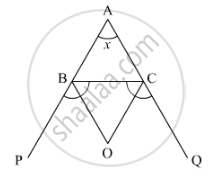
Now, according to the theorem, “if the sides AB and AC of a ΔABC are produced to P and Qrespectively and the bisectors of ∠PBC and ∠QCB intersect at O, therefore, we get,
`∠BOC = 90^\circ - 1/2 ∠A`
Hence, in ΔABC
`∠BOC = 90^\circ - 1/2 ∠A`
`∠BOC = 90^\circ - 1/2 x`
Thus,
`∠BOC = 90^\circ - x/2`
APPEARS IN
संबंधित प्रश्न
In a Δ ABC, the internal bisectors of ∠B and ∠C meet at P and the external bisectors of ∠B and ∠C meet at Q, Prove that ∠BPC + ∠BQC = 180°.
In the given figure, AB divides ∠DAC in the ratio 1 : 3 and AB = DB. Determine the value of x.
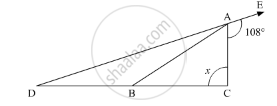
State exterior angle theorem.
If two sides of a triangle are 5 cm and 1.5 cm, the length of its third side cannot be ______.
State, if the triangle is possible with the following angles :
125°, 40°, and 15°
Calculate the unknown marked angles of the following figure :
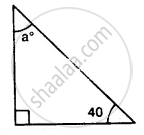
In the following, find the marked unknown angle:
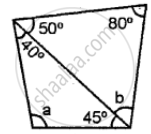
Find, giving a reason, the unknown marked angles, in a triangle drawn below:
The length of the three segments is given for constructing a triangle. Say whether a triangle with these sides can be drawn. Give the reason for your answer.
8.4 cm, 16.4 cm, 4.9 cm
How is a vertex of triangle △ABC most accurately defined?
