Advertisements
Advertisements
Question
The bisects of exterior angle at B and C of ΔABC meet at O. If ∠A = x°, then ∠BOC =
Options
- \[90^\circ + \frac{x^\circ }{2}\]
\[90^\circ - \frac{x^\circ }{2}\]
\[180^\circ + \frac{x^\circ }{2}\]
\[180^\circ - \frac{x^\circ }{2}\]
Advertisements
Solution
In the given figure, bisects of exterior angles ∠Band ∠C meet at O and ∠A = x°
We need to find ext. ∠BOC
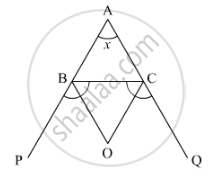
Now, according to the theorem, “if the sides AB and AC of a ΔABC are produced to P and Qrespectively and the bisectors of ∠PBC and ∠QCB intersect at O, therefore, we get,
`∠BOC = 90^\circ - 1/2 ∠A`
Hence, in ΔABC
`∠BOC = 90^\circ - 1/2 ∠A`
`∠BOC = 90^\circ - 1/2 x`
Thus,
`∠BOC = 90^\circ - x/2`
APPEARS IN
RELATED QUESTIONS
Can a triangle have two obtuse angles? Justify your answer in case.
Can a triangle have All angles more than 60°? Justify your answer in case.
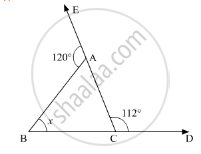
Compute the value of x in the following figure:
Define a triangle.
In ΔPQR, If ∠R > ∠Q then ______.
State, if the triangle is possible with the following angles :
40°, 130°, and 20°
The exterior angle of a triangle is equal to the sum of two
Can 30°, 60° and 90° be the angles of a triangle?
The number of triangles in the following figure is ______.

Can we have two acute angles whose sum is a straight angle? Why or why not?
