Advertisements
Advertisements
Question
If the side BC of ΔABC is produced on both sides, then write the difference between the sum of the exterior angles so formed and ∠A.
Advertisements
Solution
In the given problem, we need to find the difference between the sum of the exterior angles and∠A.
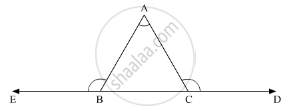
Now, according to the exterior angle theorem
ext. ∠C = ∠A + ∠B .........(1)
Also,
ext. ∠B = ∠A + ∠C .........(2)
Further, adding (1) and (2)
ext. ∠C + ext. ∠B = ∠A + ∠B + ∠A + ∠B
=2∠A+ ∠B + ∠C .........(3)
Also, according to the angle sum property of the triangle, we get,
∠A + ∠B + ∠C = 180° .........(4)
Now, we need to find the difference between the sum of the exterior angles and ∠A
Thus,
( ext. ∠C + ext. ∠B) - ∠A = (2∠A + ∠B + ∠C ) - ∠A
= ∠A = ∠B + ∠C
= 180°(Using 4)
Therefore, (ext. ∠C ext.∠B) -∠A = 180°
APPEARS IN
RELATED QUESTIONS
If one angle of a triangle is equal to the sum of the other two, show that the triangle is a
right triangle.
Is the following statement true and false :
Sum of the three angles of a triangle is 180 .
Fill in the blank to make the following statement true:
Sum of the angles of a triangle is ....
If the angles of a triangle are equal, find its angles.
Can a triangle together have the following angles?
55°, 55° and 80°
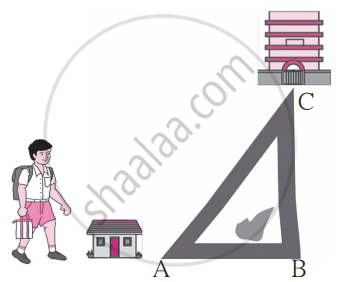
As shown in the figure, Avinash is standing near his house. He can choose from two roads to go to school. Which way is shorter? Explain why.
The length of the three segments is given for constructing a triangle. Say whether a triangle with these sides can be drawn. Give the reason for your answer.
9 cm, 6 cm, 16 cm
The correct statement out of the following is 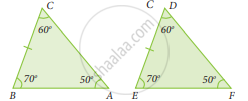
One of the angles of a triangle is 65°. If the difference of the other two angles is 45°, then the two angles are
In the given figure, AB is parallel to CD. Then the value of b is