Advertisements
Advertisements
Question
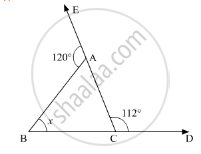
Compute the value of x in the following figure:
Advertisements
Solution
In the given problem, we need to find the value of x
In the given ΔABC, ∠ACD = 112° and ∠BAE = 120°
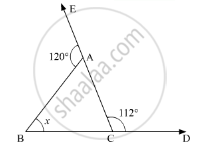
Now, BCD is a straight line. So, using the property, “the angles forming a linear pair are supplementary”, we get,
∠ABC + ∠ACD = 180°
∠ABC + 112 = 180°
∠ACB = 180° - 112°
∠ACB = 68°
Similarly, EAC is a straight line. So, we get,
∠BAE + ∠BAC = 180°
120° + ∠BAC = 180°
∠BAC = 180° - 120°
∠BAC = 60°
Further, using the angle sum property of a triangle,
In ΔABC
∠ACB + ∠BAC + ∠ABC = 180°
68° + 60° + ∠ABC = 180°
128° + ∠ABC = 180° -128°
∠ABC = 52°
Therefore, x = 52°
APPEARS IN
RELATED QUESTIONS
ABC is a triangle in which ∠A — 72°, the internal bisectors of angles B and C meet in O.
Find the magnitude of ∠BOC.
In Δ ABC, BD⊥ AC and CE ⊥ AB. If BD and CE intersect at O, prove that ∠BOC = 180° − A.
One angle of a triangle is 61° and the other two angles are in the ratio `1 1/2: 1 1/3`. Find these angles.
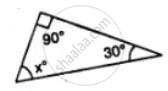
Calculate the unknown marked angles of the following figure :
In the following figure, l || m and M is the mid-point of a line segment AB. Show that M is also the mid-point of any line segment CD, having its end points on l and m, respectively.

P is a point on the bisector of ∠ABC. If the line through P, parallel to BA meet BC at Q, prove that BPQ is an isosceles triangle.
Prove that in a triangle, other than an equilateral triangle, angle opposite the longest side is greater than `2/3` of a right angle.
The number of angles in the following figure is ______.

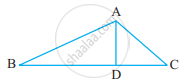
Which two triangles have ∠B in common?
How is a vertex of triangle △ABC most accurately defined?
