Advertisements
Advertisements
Question
Is the following statement true and false :
An exterior angle of a triangle is less than either of its interior opposite angles.
Options
Ture
False
Advertisements
Solution
An exterior angle of a triangle is less than either of its interior opposite angles
According to the exterior angle property, an exterior angle of a triangle is equal to the sum of the two opposite interior angles.
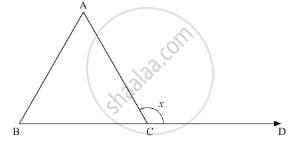
In ΔABC
Let x be the exterior angle
So,
x = ∠CAB +∠CBA
Now, if x is less than either of its interior opposite angles
x < ∠CAB +∠CBA
APPEARS IN
RELATED QUESTIONS
Can a triangle have All angles equal to 60°? Justify your answer in case.
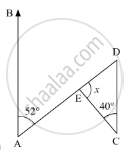
Compute the value of x in the following figure:
Is the following statement true and false :
If one angle of a triangle is obtuse, then it cannot be a right angled triangle.
Fill in the blank to make the following statement true:
An exterior angle of a triangle is equal to the two ....... opposite angles.
In a Δ ABC, AD bisects ∠A and ∠C > ∠B. Prove that ∠ADB > ∠ADC.
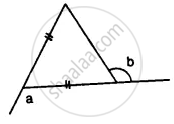
In the given figure, express a in terms of b.
Can a triangle together have the following angles?
33°, 74° and 73°
Bisectors of the angles B and C of an isosceles triangle with AB = AC intersect each other at O. BO is produced to a point M. Prove that ∠MOC = ∠ABC.
In the following figure, AD is the bisector of ∠BAC. Prove that AB > BD.
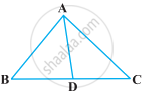
In the following figure, AB = BC and AD = BD = DC. The number of isosceles triangles in the figure is ______.

