Advertisements
Advertisements
Question
Is the following statement true and false :
An exterior angle of a triangle is equal to the sum of the two interior opposite angles.
Options
Ture
False
Advertisements
Solution
An exterior angle of a triangle is equal to the sum of the two interior opposite angles.
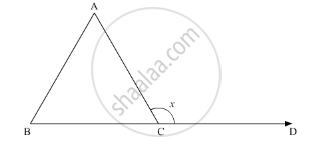
According to exterior angle theorem,
ext.x ∠CAB +∠CBA
APPEARS IN
RELATED QUESTIONS
Can a triangle have All angles equal to 60°? Justify your answer in case.
Determine the measure of each of the equal angles of a right-angled isosceles triangle.
OR
ABC is a right-angled triangle in which ∠A = 90° and AB = AC. Find ∠B and ∠C.
Is the following statement true and false :
A triangle can have two right angles.
In a Δ ABC, AD bisects ∠A and ∠C > ∠B. Prove that ∠ADB > ∠ADC.
Mark the correct alternative in each of the following:
If all the three angles of a triangle are equal, then each one of them is equal to
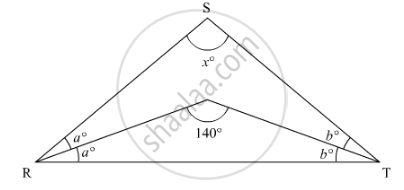
In ΔRST (See figure), what is the value of x?
State, if the triangle is possible with the following angles :
125°, 40°, and 15°
One angle of a right-angled triangle is 70°. Find the other acute angle.
Find, giving a reason, the unknown marked angles, in a triangle drawn below:

How is a vertex of triangle △ABC most accurately defined?
