Advertisements
Advertisements
Question
The angles of a triangle are (x − 40)°, (x − 20)° and `(1/2x-10)^@.` find the value of x
Advertisements
Solution
Given that
The angles of triangle are
`(x-40^@),(x-20)^@ and (x/2-10)^@`
We know that
Sum of all angles of traingle is `180^@`
∴ `x-40^@+x-20^@+x/2-10^@=180^@`
`2x+x/2-70^@=180^@`
`(5x)/2=180+70^@`
`5x=250^@(2)`
`x=50^@(2)`
`x=100^@`
∴ `x=100^@`
APPEARS IN
RELATED QUESTIONS
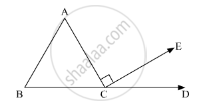
In the given figure, AC ⊥ CE and ∠A : ∠B : ∠C = 3 : 2 : 1, find the value of ∠ECD.
Is the following statement true and false :
An exterior angle of a triangle is less than either of its interior opposite angles.
Fill in the blank to make the following statement true:
An exterior angle of a triangle is always ......... than either of the interior opposite angles.
If the side BC of ΔABC is produced on both sides, then write the difference between the sum of the exterior angles so formed and ∠A.
If two acute angles of a right triangle are equal, then each acute is equal to
If one angle of a triangle is equal to the sum of the other two angles, then the triangle is
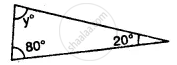
Calculate the unknown marked angles of the following figure :
The length of the sides of the triangle is given. Say what types of triangles they are 4.3 cm, 4.3 cm, 4.3 cm.
Can 30°, 60° and 90° be the angles of a triangle?
The sides of a triangle must always be connected so that:
