Advertisements
Advertisements
Question
Two angles of a triangle are equal and the third angle is greater than each of those angles
by 30°. Determine all the angles of the triangle.
Advertisements
Solution
Given that,
Two angles are equal and the third angle is greater than each of those angles `by 30^@` Let x, x, x+30 be the angles of a triangle
We know that
Sum of all angles of a triangle is `180^@`
`x+x+x+30=180^@`
`3x+30=180^@`
`3x=180^@-30^@`
`3x=150^@`
`x=150^@/3`
`x=50^@`
∴ The angles are x,x,x+30
`x=50^@`
`x+30=80^@`
∴ The required angles are `50^@,50^@, 80^@`
APPEARS IN
RELATED QUESTIONS
The angles of a triangle are arranged in ascending order of magnitude. If the difference
between two consecutive angles is 10°, find the three angles.
Can a triangle have All angles less than 60° Justify your answer in case.
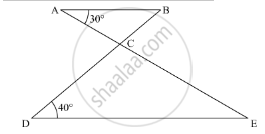
In the given figure, AB || DE. Find ∠ACD.
Is the following statement true and false :
Sum of the three angles of a triangle is 180 .
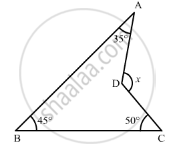
In the given figure, compute the value of x.
In ΔABC, if bisectors of ∠ABC and ∠ACB intersect at O at angle of 120°, then find the measure of ∠A.
If one angle of a triangle is equal to the sum of the other two angles, then the triangle is
An exterior angle of a triangle is 108° and its interior opposite angles are in the ratio 4 : 5. The angles of the triangle are
In a triangle ABC, ∠A = 45° and ∠B = 75°, find ∠C.
Classify the following triangle according to angle:

