Advertisements
Advertisements
Question
The angle of a vertex of an isosceles triangle is 100°. Find its base angles.
Advertisements
Solution
In Δ ABC,

∵ AB = AC.
∴ ∠B = ∠C
But ∠A = 100°
and ∠A + ∠B + ∠C = 180° ..........(Angles of a triangle)
⇒ 100° + ∠B + ∠B = 180°
⇒ 2 ∠B = 180°− 100°
⇒ 2 ∠B = 80°
∴ ∠B =`(80°)/2=40°`
Hence ∠B = ∠C = 40°
APPEARS IN
RELATED QUESTIONS
If the bisectors of the base angles of a triangle enclose an angle of 135°, prove that the triangle is a right triangle.
Can a triangle have All angles equal to 60°? Justify your answer in case.
Is the following statement true and false :
All the angles of a triangle can be greater than 60°.
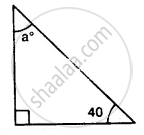
Calculate the unknown marked angles of the following figure :
Find x, if the angles of a triangle is:
2x°, 4x°, 6x°
Classify the following triangle according to sides:

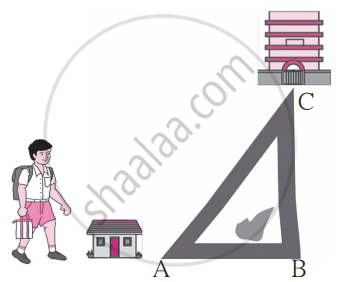
As shown in the figure, Avinash is standing near his house. He can choose from two roads to go to school. Which way is shorter? Explain why.
The length of the sides of the triangle is given. Say what types of triangles they are 3 cm, 4 cm, 5 cm.
Find all the three angles of the ΔABC
The number of triangles in the following figure is ______. Their names are ______.

