Advertisements
Advertisements
प्रश्न
The angle of a vertex of an isosceles triangle is 100°. Find its base angles.
Advertisements
उत्तर
In Δ ABC,

∵ AB = AC.
∴ ∠B = ∠C
But ∠A = 100°
and ∠A + ∠B + ∠C = 180° ..........(Angles of a triangle)
⇒ 100° + ∠B + ∠B = 180°
⇒ 2 ∠B = 180°− 100°
⇒ 2 ∠B = 80°
∴ ∠B =`(80°)/2=40°`
Hence ∠B = ∠C = 40°
APPEARS IN
संबंधित प्रश्न
Is the following statement true and false :
An exterior angle of a triangle is less than either of its interior opposite angles.
Is the following statement true and false :
An exterior angle of a triangle is equal to the sum of the two interior opposite angles.
Mark the correct alternative in each of the following:
If all the three angles of a triangle are equal, then each one of them is equal to
State, if the triangle is possible with the following angles :
125°, 40°, and 15°
Find the unknown marked angles in the given figure:
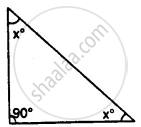
In the following, find the marked unknown angle:
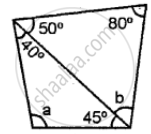
If an angle of a triangle is equal to the sum of the other two angles, find the type of the triangle
S is any point on side QR of a ∆PQR. Show that: PQ + QR + RP > 2PS.
The image of an object placed at a point A before a plane mirror LM is seen at the point B by an observer at D as shown in the following figure. Prove that the image is as far behind the mirror as the object is in front of the mirror.
[Hint: CN is normal to the mirror. Also, angle of incidence = angle of reflection].
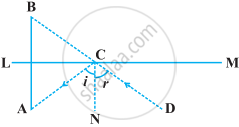
The number of triangles in the following figure is ______. Their names are ______.

