Advertisements
Advertisements
प्रश्न
In the given figure, show that: ∠a = ∠b + ∠c
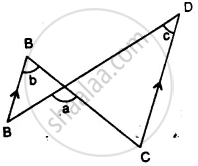
(i) If ∠b = 60° and ∠c = 50° ; find ∠a.
(ii) If ∠a = 100° and ∠b = 55° : find ∠c.
(iii) If ∠a = 108° and ∠c = 48° ; find ∠b.
Advertisements
उत्तर
∵ AB || CD
∴ b = c and ∠A = ∠C ........(Alternate angles)
Now in Δ PCD,
Ext. ∠APC = ∠C + ∠D
⇒ a = b + c
(i) If b = 60°, c = 50°, then
a = b + c = 60° + 50° = 110°
(ii) If a = 100° and b = 55°,
then a = b + c
⇒ 100° = 55°+ c
⇒ c = 100°− 55° = 45°
(iii) If a = 108° and c = 48°
then a = b + c
⇒ 108° = b + 48°
⇒ b = 108°− 48° = 60°
APPEARS IN
संबंधित प्रश्न
Is the following statement true and false :
All the angles of a triangle can be less than 60°
Fill in the blank to make the following statement true:
A triangle cannot have more than ...... right angles.
In ΔABC, if bisectors of ∠ABC and ∠ACB intersect at O at angle of 120°, then find the measure of ∠A.
Mark the correct alternative in each of the following:
If all the three angles of a triangle are equal, then each one of them is equal to
If two acute angles of a right triangle are equal, then each acute is equal to
State, if the triangle is possible with the following angles :
20°, 70°, and 90°
In a triangle PQR, ∠P = 60° and ∠Q = ∠R, find ∠R.
Find x, if the angles of a triangle is:
x°, 2x°, 2x°
Match the following:
| Column A | Column B |
| (i) No sides are equal | Isosceles triangle |
| (ii) One right angle | Scalene triangle |
| (iii) One obtuse angle | Right angled triangle |
| (iv) Two sides of equal length | Equilateral triangle |
| (v) All sides are equal | Obtuse angled triangle |
In the following figure, PQ ⊥ RQ, PQ = 5 cm and QR = 5 cm. Then ∆PQR is ______.

