Advertisements
Advertisements
प्रश्न
In ΔABC, if bisectors of ∠ABC and ∠ACB intersect at O at angle of 120°, then find the measure of ∠A.
Advertisements
उत्तर
In the given ΔABC, ∠ABC = ∠ACB, the bisectors of ∠ABC and ∠ACBmeet at O and ∠BOC = 120°
We need to find the measure of ∠A

So here, using the corollary, “if the bisectors of ∠ABCand ∠ACBof a ΔABCmeet at a point O, then`∠BOC = 90° + 1/2 ∠A`
Thus, in ΔABC
`∠BOC = 90° + 1/2 ∠A`
` 120° = 90° + 1/2 ∠A`
`120° - 90° + 1/2 ∠A`
∠A = 2(30°)
∠A= 60°
Thus, ∠A = 60°
APPEARS IN
संबंधित प्रश्न
In a ΔABC, if ∠A = 55°, ∠B = 40°, find ∠C.
Can a triangle have two right angles? Justify your answer in case.
Fill in the blank to make the following statement true:
An exterior angle of a triangle is always ......... than either of the interior opposite angles.
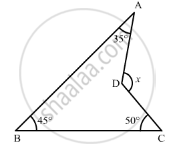
In the given figure, compute the value of x.
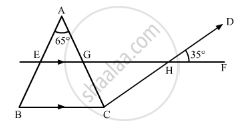
In the given figure, if AB || CD, EF || BC, ∠BAC = 65° and ∠DHF = 35°, find ∠AGH.
If two acute angles of a right triangle are equal, then each acute is equal to
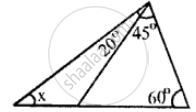
In the following, find the marked unknown angle:
In ∆ABC, ∠A = ∠B = 62° ; find ∠C.
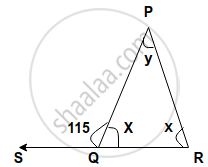
Find, giving a reason, the unknown marked angles, in a triangle drawn below:
The length of the three segments is given for constructing a triangle. Say whether a triangle with these sides can be drawn. Give the reason for your answer.
12 cm, 12 cm, 16 cm
