Advertisements
Advertisements
प्रश्न
An exterior angle of a triangle is equal to 100° and two interior opposite angles are equal. Each of these angles is equal to
पर्याय
75°
80°
80°
40°
50°
Advertisements
उत्तर
n the ΔABC, CD is the ray extended from the vertex C of ΔABC. It is given that the exterior angle of the triangle is 100° and two of the interior opposite angles are equal.
So, ∠ACD = 100° and A = ∠B
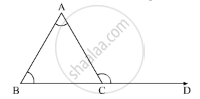
So, now using the property, “an exterior angle of the triangle is equal to the sum of the two opposite interior angles”, we get.
In ΔABC
∠A + ∠B = ∠ACD
∠2A = 100°
`∠A = (100°)/2`
∠A = 50°
∠A = ∠B = 50°
Therefore, each of the two opposite interior angles is 50°.
APPEARS IN
संबंधित प्रश्न
ABC is a triangle in which ∠A — 72°, the internal bisectors of angles B and C meet in O.
Find the magnitude of ∠BOC.
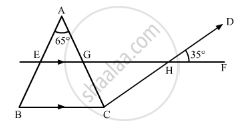
In the given figure, if AB || CD, EF || BC, ∠BAC = 65° and ∠DHF = 35°, find ∠AGH.
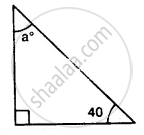
Calculate the unknown marked angles of the following figure :
Calculate the angles of a triangle if they are in the ratio 4: 5: 6.
One of the base angles of an isosceles triangle is 52°. Find its angle of the vertex.
Find, giving a reason, the unknown marked angles, in a triangle drawn below:

The length of the sides of the triangle is given. Say what types of triangles they are 4.3 cm, 4.3 cm, 4.3 cm.
The length of the three segments is given for constructing a triangle. Say whether a triangle with these sides can be drawn. Give the reason for your answer.
12 cm, 12 cm, 16 cm
Can we have two acute angles whose sum is an obtuse angle? Why or why not?
Can we have two acute angles whose sum is a reflex angle? Why or why not?
