Advertisements
Advertisements
Question
An exterior angle of a triangle is equal to 100° and two interior opposite angles are equal. Each of these angles is equal to
Options
75°
80°
80°
40°
50°
Advertisements
Solution
n the ΔABC, CD is the ray extended from the vertex C of ΔABC. It is given that the exterior angle of the triangle is 100° and two of the interior opposite angles are equal.
So, ∠ACD = 100° and A = ∠B
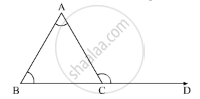
So, now using the property, “an exterior angle of the triangle is equal to the sum of the two opposite interior angles”, we get.
In ΔABC
∠A + ∠B = ∠ACD
∠2A = 100°
`∠A = (100°)/2`
∠A = 50°
∠A = ∠B = 50°
Therefore, each of the two opposite interior angles is 50°.
APPEARS IN
RELATED QUESTIONS
Is the following statement true and false :
A triangle can have two right angles.
Is the following statement true and false :
An exterior angle of a triangle is less than either of its interior opposite angles.
Is the following statement true and false :
An exterior angle of a triangle is greater than the opposite interior angles.
Fill in the blank to make the following statement true:
A triangle cannot have more than ...... right angles.
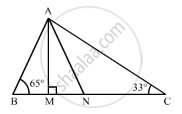
In the given figure, AM ⊥ BC and AN is the bisector of ∠A. If ∠B = 65° and ∠C = 33°, find ∠MAN.
If one angle of a triangle is equal to the sum of the other two angles, then the triangle is
State, if the triangle is possible with the following angles :
20°, 70°, and 90°
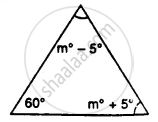
Find the unknown marked angles in the given figure:
D is any point on side AC of a ∆ABC with AB = AC. Show that CD < BD.
The number of triangles in the following figure is ______. Their names are ______.

