Advertisements
Advertisements
Question
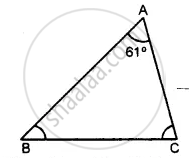
One angle of a triangle is 61° and the other two angles are in the ratio `1 1/2: 1 1/3`. Find these angles.
Advertisements
Solution
In Δ ABC,
Let ∠A = 61°
But ∠A + ∠B + ∠C = 180° ........(Angles of a triangle)
⇒ 61° + ∠B + ∠C = 180°
⇒ ∠B + ∠C = 180°− 61° = 119°
But ∠B: ∠C =`1 1/2:1 1/3=3/2:4/3`
`=(9:8)/6`
=9: 8
Let ∠B = 9x and ∠C = 8x,
then, 9x + 8x = 119°
⇒ 17x = 119°
⇒ x =`(119°)/17=7°`
∴ ∠B = 9x = 9 × 7° = 63°
∠C = 8x = 8 × 7° = 56°
APPEARS IN
RELATED QUESTIONS
Two angles of a triangle are equal and the third angle is greater than each of those angles
by 30°. Determine all the angles of the triangle.
Can a triangle have two acute angles?Justify your answer in case.
Determine the measure of each of the equal angles of a right-angled isosceles triangle.
OR
ABC is a right-angled triangle in which ∠A = 90° and AB = AC. Find ∠B and ∠C.
Fill in the blank to make the following statement true:
A triangles cannot have more than ......obtuse angles.
If the angles of a triangle are equal, find its angles.
Find x, if the angles of a triangle is:
x°, x°, x°
Can 30°, 60° and 90° be the angles of a triangle?
One of the angles of a triangle is 65°. If the difference of the other two angles is 45°, then the two angles are
Bisectors of the angles B and C of an isosceles triangle with AB = AC intersect each other at O. BO is produced to a point M. Prove that ∠MOC = ∠ABC.
How is a vertex of triangle △ABC most accurately defined?
