Advertisements
Advertisements
प्रश्न
One angle of a triangle is 61° and the other two angles are in the ratio `1 1/2: 1 1/3`. Find these angles.
Advertisements
उत्तर
In Δ ABC,
Let ∠A = 61°
But ∠A + ∠B + ∠C = 180° ........(Angles of a triangle)
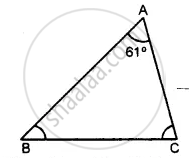
⇒ 61° + ∠B + ∠C = 180°
⇒ ∠B + ∠C = 180°− 61° = 119°
But ∠B: ∠C =`1 1/2:1 1/3=3/2:4/3`
`=(9:8)/6`
=9: 8
Let ∠B = 9x and ∠C = 8x,
then, 9x + 8x = 119°
⇒ 17x = 119°
⇒ x =`(119°)/17=7°`
∴ ∠B = 9x = 9 × 7° = 63°
∠C = 8x = 8 × 7° = 56°
APPEARS IN
संबंधित प्रश्न
AB is a line segment. P and Q are points on opposite sides of AB such that each of them is equidistant from the points A and B (See Fig. 10.26). Show that the line PQ is perpendicular bisector of AB.
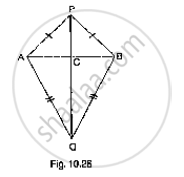
Is the following statement true and false :
All the angles of a triangle can be less than 60°
In a Δ ABC, AD bisects ∠A and ∠C > ∠B. Prove that ∠ADB > ∠ADC.
State exterior angle theorem.
In ΔPQR, If ∠R > ∠Q then ______.
If the angles of a triangle are equal, find its angles.
One of the base angles of an isosceles triangle is 52°. Find its angle of the vertex.
Classify the following triangle according to sides:

In the following figure, ∠BAC = 90° and AD ⊥ BC. The number of right triangles in the figure is ______.

What is common in the following figure?
 |
 |
| (i) | (ii) |
Is figure (i) that of triangle? if not, why?
