Advertisements
Advertisements
Question
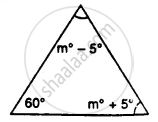
Find the unknown marked angles in the given figure:
Advertisements
Solution
In the figure,
∠A + ∠B + ∠C = 180° .....(Sum of angles of a triangle)
(m°− 5°) + 60° + (m°+ 5°) = 180°
⇒ m°− 5° + 60° + m° + 5° = 180°
⇒ 2m° = 180°− 65° + 5°
⇒ 2m° = 120°
⇒ ∴ m° = `(120°)/2=60°`
Hence ∠A = m°− 5° = 60°− 5° = 55°
and ∠C = m° + 5° = 60° + 5° = 65°
APPEARS IN
RELATED QUESTIONS
Is the following statement true and false :
A triangle can have two obtuse angles.
Is the following statement true and false :
An exterior angle of a triangle is less than either of its interior opposite angles.
Is the following statement true and false :
An exterior angle of a triangle is equal to the sum of the two interior opposite angles.
In Δ ABC, if u∠B = 60°, ∠C = 80° and the bisectors of angles ∠ABC and ∠ACB meet at a point O, then find the measure of ∠BOC.
One angle of a triangle is 60°. The other two angles are in the ratio of 5: 7. Find the two angles.
Find x, if the angles of a triangle is:
x°, x°, x°
One angle of a right-angled triangle is 70°. Find the other acute angle.
The length of the three segments is given for constructing a triangle. Say whether a triangle with these sides can be drawn. Give the reason for your answer.
17 cm, 7 cm, 8 cm
The correct statement out of the following is 
The number of triangles in the following figure is ______.

