Advertisements
Advertisements
Question
Q is a point on the side SR of a ∆PSR such that PQ = PR. Prove that PS > PQ.
Advertisements
Solution
In triangle PSR, Q is a point on the side SR such that PQ = PR.
To proof that PS > PQ
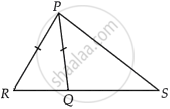
Proof: In triangle PRQ,
PQ = PR ...[Given]
∠R = ∠PQR ...(i) [Angle opposite to equal sides are equal]
∠PQR > ∠S ...(ii) [Exterior angle of a triangle is greater than each of the opposite interior angle]
Now, from equation (i) and (ii), we get
∠R > ∠S
PS > PR ...[Side opposite to greater angle is longer]
PS > PQ ...[PQ = PR]
APPEARS IN
RELATED QUESTIONS
Can a triangle have All angles more than 60°? Justify your answer in case.
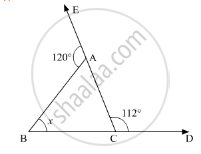
Compute the value of x in the following figure:
Fill in the blank to make the following statement true:
Sum of the angles of a triangle is ....
State exterior angle theorem.
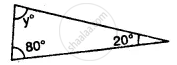
Calculate the unknown marked angles of the following figure :
One angle of a triangle is 60°. The other two angles are in the ratio of 5: 7. Find the two angles.
Can a triangle together have the following angles?
33°, 74° and 73°
The length of the three segments is given for constructing a triangle. Say whether a triangle with these sides can be drawn. Give the reason for your answer.
17 cm, 7 cm, 8 cm
In the following figure, ∠BAC = 90° and AD ⊥ BC. The number of right triangles in the figure is ______.

The number of triangles in the following figure is ______. Their names are ______.

