Advertisements
Advertisements
Question
ABC is a triangle in which ∠A — 72°, the internal bisectors of angles B and C meet in O.
Find the magnitude of ∠BOC.
Advertisements
Solution

Given,
ABC is a triangle
`∠ A=72^@` and internal bisector of angles B and C meeting O
In` Δ ABC = ∠ A+∠ B+∠ C=180^@`
⇒`72^@+∠ B+∠ C=180^@`
⇒`∠ B+∠C =180^@-72^@ ` divide both sides by ‘2’
⇒`∠ B/2+∠ C/2=108^@/2` ..................(1)
⇒`∠ OBC +∠ OCB =54^@` ...................(1)
Now in `Δ BOC⇒ ∠OBC +∠ OCB +∠ BOC = 180^@`
⇒ `54^@+∠BOC=180^@`
⇒ `∠BOC=180^@-54^@=126^@`
∴` ∠ BOC=126^@`
APPEARS IN
RELATED QUESTIONS
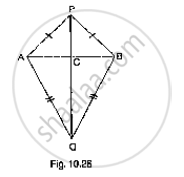
AB is a line segment. P and Q are points on opposite sides of AB such that each of them is equidistant from the points A and B (See Fig. 10.26). Show that the line PQ is perpendicular bisector of AB.
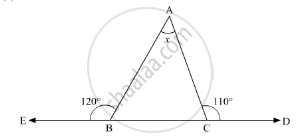
Compute the value of x in the following figure:
Is the following statement true and false :
A triangle can have two right angles.
In Δ ABC, BD⊥ AC and CE ⊥ AB. If BD and CE intersect at O, prove that ∠BOC = 180° − A.
State exterior angle theorem.
In a triangle PQR, ∠P = 60° and ∠Q = ∠R, find ∠R.
In the following, find the marked unknown angle:
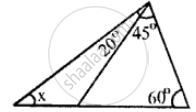
Find x, if the angles of a triangle is:
2x°, 4x°, 6x°
The length of the sides of the triangle is given. Say what types of triangles they are 3.4 cm, 3.4 cm, 5 cm.
The length of the sides of the triangle is given. Say what types of triangles they are 3.7 cm, 3.4 cm, 4 cm.
