Advertisements
Advertisements
प्रश्न
ABC is a triangle in which ∠A — 72°, the internal bisectors of angles B and C meet in O.
Find the magnitude of ∠BOC.
Advertisements
उत्तर

Given,
ABC is a triangle
`∠ A=72^@` and internal bisector of angles B and C meeting O
In` Δ ABC = ∠ A+∠ B+∠ C=180^@`
⇒`72^@+∠ B+∠ C=180^@`
⇒`∠ B+∠C =180^@-72^@ ` divide both sides by ‘2’
⇒`∠ B/2+∠ C/2=108^@/2` ..................(1)
⇒`∠ OBC +∠ OCB =54^@` ...................(1)
Now in `Δ BOC⇒ ∠OBC +∠ OCB +∠ BOC = 180^@`
⇒ `54^@+∠BOC=180^@`
⇒ `∠BOC=180^@-54^@=126^@`
∴` ∠ BOC=126^@`
APPEARS IN
संबंधित प्रश्न
If the bisectors of the base angles of a triangle enclose an angle of 135°, prove that the triangle is a right triangle.
The exterior angles, obtained on producing the base of a triangle both way are 104° and 136°. Find all the angles of the triangle.
If two sides of a triangle are 5 cm and 1.5 cm, the length of its third side cannot be ______.
State, if the triangle is possible with the following angles :
125°, 40°, and 15°
In a triangle ABC, ∠A = 45° and ∠B = 75°, find ∠C.
Find the unknown marked angles in the given figure:
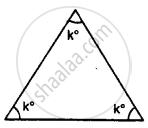
Calculate the angles of a triangle if they are in the ratio 4: 5: 6.
In the following, find the marked unknown angle:
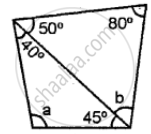
AB and CD are the smallest and largest sides of a quadrilateral ABCD. Out of ∠B and ∠D decide which is greater.
Can we have two acute angles whose sum is a reflex angle? Why or why not?
