Advertisements
Advertisements
प्रश्न
ABC is a triangle in which ∠A — 72°, the internal bisectors of angles B and C meet in O.
Find the magnitude of ∠BOC.
Advertisements
उत्तर

Given,
ABC is a triangle
`∠ A=72^@` and internal bisector of angles B and C meeting O
In` Δ ABC = ∠ A+∠ B+∠ C=180^@`
⇒`72^@+∠ B+∠ C=180^@`
⇒`∠ B+∠C =180^@-72^@ ` divide both sides by ‘2’
⇒`∠ B/2+∠ C/2=108^@/2` ..................(1)
⇒`∠ OBC +∠ OCB =54^@` ...................(1)
Now in `Δ BOC⇒ ∠OBC +∠ OCB +∠ BOC = 180^@`
⇒ `54^@+∠BOC=180^@`
⇒ `∠BOC=180^@-54^@=126^@`
∴` ∠ BOC=126^@`
APPEARS IN
संबंधित प्रश्न
Fill in the blank to make the following statement true:
An exterior angle of a triangle is always ......... than either of the interior opposite angles.
State, if the triangle is possible with the following angles :
20°, 70°, and 90°
Calculate the unknown marked angles of the following figure :
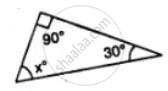
Find x, if the angles of a triangle is:
2x°, 4x°, 6x°
The angles of the triangle are 3x – 40, x + 20 and 2x – 10 then the value of x is
In a ∆ABC, AB = AC. The value of x is ________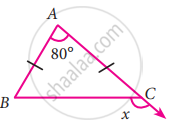
S is any point on side QR of a ∆PQR. Show that: PQ + QR + RP > 2PS.
The number of triangles in the following figure is ______. Their names are ______.

How many sides does a triangle have?
How many angles are there inside a triangle?
