Advertisements
Advertisements
प्रश्न
In Δ ABC, BD⊥ AC and CE ⊥ AB. If BD and CE intersect at O, prove that ∠BOC = 180° − A.
Advertisements
उत्तर
In the given ΔABC, BD⊥AC and CE⊥AB.
We need prove ∠BOC = 180° - ∠A
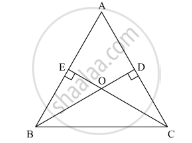
Here, in ΔBDC, using the exterior angle theorem, we get,
∠BDA = ∠DBC + ∠DBC
90 = ∠DBO + ∠DBC ................ (1)
Similarly, in ΔEBC, we get,
∠AEC = ∠EBC + ∠ECB
90 = ∠EBC ∠ECB ................ (2)
Adding (1) and (2), we get,
90 + 90 = ∠DBC + ∠DCB + ∠EBC + ∠ECB
180 = (∠DCB +∠EBC) + (∠DBC+∠ECB)................ (3)
Now, on using angle sum property,
In ΔABC, we get,
∠BAC + ∠ABC + ∠ACB = 180
∠ABC + ∠ACB = 180 - ∠BAC
This can be written as,
∠EBC + ∠DCB = 180 - ∠A ......... (4)
Similarly, using angle sum property in ΔOBC, we get,
∠BOC + ∠OBC + ∠OCB = 180
∠OBC + ∠OCB = 180 - ∠BOC
This can be written as,
∠DBC + ∠ECB = 180 - ∠BOC ......... (5)
Now, using the values of (4) and (5) in (3), we get,
180 = 180 - ∠BOC ........... (5)
180 = 360 - ∠A - ∠BOC
∠BOC = 360 - 180 - ∠A
∠BOC = 180 - ∠A
Therefore, ∠BOC = 180 - ∠A.
Hence proved
APPEARS IN
संबंधित प्रश्न
The bisectors of base angles of a triangle cannot enclose a right angle in any case.
In a ΔABC, ∠ABC = ∠ACB and the bisectors of ∠ABC and ∠ACB intersect at O such that ∠BOC = 120°. Show that ∠A = ∠B = ∠C = 60°.
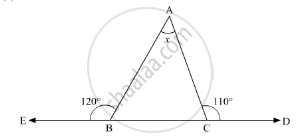
Compute the value of x in the following figure:
In a triangle PQR, ∠P = 60° and ∠Q = ∠R, find ∠R.
In the following, find the marked unknown angle:
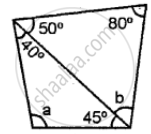
Find, giving a reason, the unknown marked angles, in a triangle drawn below:
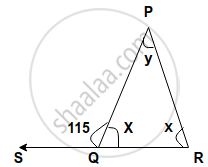
Classify the following triangle according to sides:
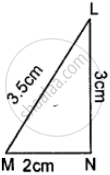
Classify the following triangle according to angle:
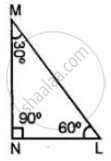
In the following figure, l || m and M is the mid-point of a line segment AB. Show that M is also the mid-point of any line segment CD, having its end points on l and m, respectively.

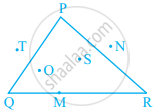
In the following figure, points lying in the interior of the triangle PQR are ______, that in the exterior are ______ and that on the triangle itself are ______.